Monday, June 12, 2017

Introduction to Paul's Letter to the Philippians: We can be confident in Christ from start to finish (philippians 1:1-11)


It’s Church statistics month in the Presbyterian church. The national church collects data like church attendance, split into different age categories, membership numbers and financial figures. They send out a letter with all the forms and instructions on how to collect and record the numbers for them.

One day at St John’s in Rotorua we received a letter asking us for statistical data on our flock. But it was not from the national church, it wasn’t really wanting data on our congregation.  The letter was from the New Zealand Perendale Sheep Breeders Association. It really made us laugh. We wrote back to them to say that we didn’t have any Perendales in our flock, we were more a mix of different sorts from all over, and that our flock’s statistics wouldn’t help them very much and what they wanted to know wouldn’t help our statistical analysis either. While there was a very humorous connection we had received a letter that was meant for someone else. 

Today, we are starting our winter sermon series at St Peter’s, and we are going to be looking at Paul’s letter to the Church at Philippi. A letter that was meant originally for someone else, not for us. A letter to a specific group in a specific time and place. Written in a specific style, in response to a specific situation.  In this case Paul is writing to the church at the city of Philippi to thank them for supporting him financially while he is in prison in Rome. Paul takes that chance to bring encouragement to his readers. Encouragement to stand firm in the face of persecution and opposition and to rejoice regardless of the circumstances, because of the good news of Jesus Christ.

There is more than a tenuous connection to us as Paul’s words have been recognised as being Spirit inspired and being God’s word to all who are ‘in Christ’. To all God’s people for all time and place, equally relevant and inspirational for you and I as they were to their original readers. Encouragement for us to ‘Stand Firm on our own joyous journey following Jesus’.
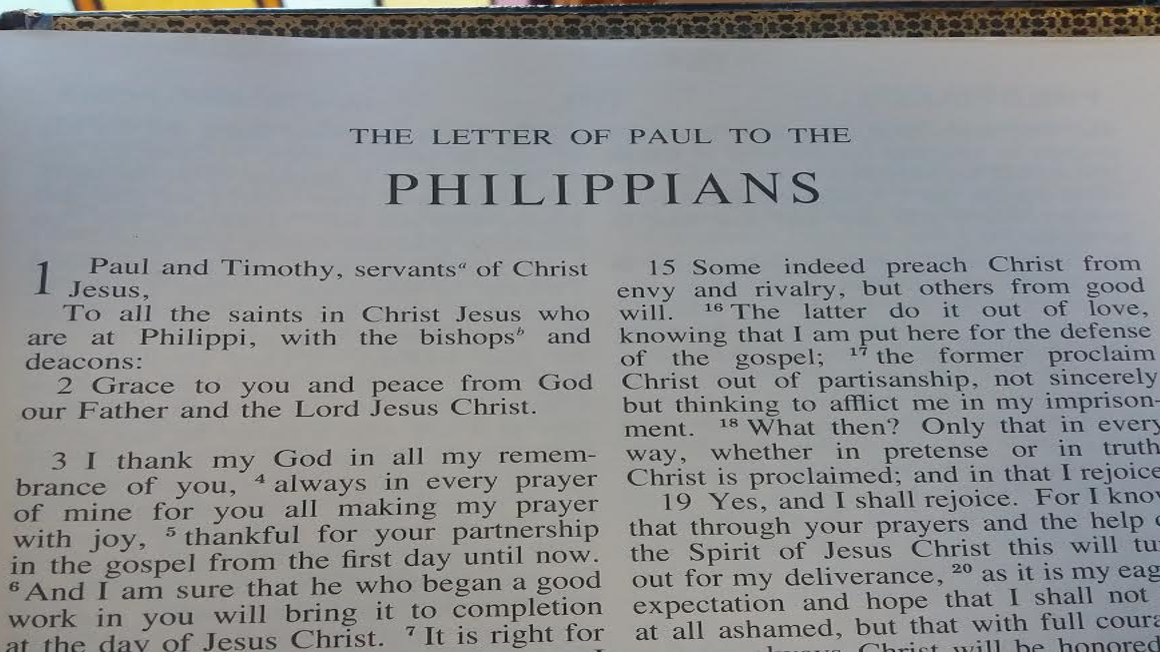
The passage we had read to us today is the formal introduction to this letter. It’s all the things a first century person would expect to see in a letter. Like you and I expect certain things when we receive a letter or an email today. It starts with who is writing, who the letter is for, a greeting, and then thanksgiving and prayer for the people being writing to.  A more expanded and personal and spiritual version of the things we might expect at the beginning of a personal letter, like, ‘I hope you are well’. You see this format in all the epistles, or letters that along with Acts and the four Gospel’s make up the New Testament.

It gives us some basic information. The Letter is written by Paul and Timothy. Paul we know from the book of Acts is an apostle of Jesus Christ. We know his history, a member of the Pharisee’s faction of the Jews, very anti-Christian, who has an encounter with the risen Jesus on his way to get Christians in Damascus arrested, and is converted to being a follower of Jesus.  He was responsible for planting churches in Asia Minor and into Europe. He planted the church in Philippi. Timothy we know from Acts as well is his protege, the young man he is training up to continue doing what Paul has been doing. Paul shares information he is in prison for the gospel, and that he is very blessed to have received a gift from the Philippian church for his support.

The letter is to the whole church in Philippi, along with its leadership team. We know from the book of Acts how the Church was established in Philippi. In fact that it was the first recoded church we have in Europe. Philippi is a major city on the trade route to Rome in Macedonia. Lydia is the first convert in Philippi, and therefore Europe. She is a Jewish merchant and immediately invites Paul and his team to base themselves at her house. The Church grows, Paul finds himself in prison after a riot caused by his delivering a slave girl of a demonic spirit, the slave girl had been making money for her master by telling fortunes. In Jail an earthquake set Paul and Silas free, but they stay put and their jailer and his family become believers. Paul does not get to stay in Philippi for long, to build up the fledgling church that meets at Lydia’s house. So as he writes to the church now he praises God that they have continued in the faith, evident by their gift to him, he acknowledges that God who started his good work in them will be able to complete it in the day of the Lord Jesus Christ, and Prays that they may continue to grow in love, as they grow in knowledge and insight in Jesus Christ. 

This is not, however, just a perfunctory form letter, that simply gives us cold clinical information  about sender and receiver, it is full of profound and inspiring truth. The whole thing can to be said to be In Jesus Christ. Inn fact paul mentions Jesus seven times in his formal opening, adress, greeting and prayer. We have the sender and receiver but who they are, their identity is given in Christ. The relationship between sender and recipient is given in Christ.  We can know the history of the sender and recipients, but their times, past, present and future are held in Christ.  The blessings and deep-felt prayer for the church at Philippi come from being in Christ.

Paul introduces himself and Timothy, as servants of Jesus Christ. It would be easy for him write as the person who founded the Church or one with Authority because of his position in the fledgling Christian group, but rather he sees himself as a servant. The word actually means slave, one who has been bought with a price and who goes about the business of his master. This is how Paul sees himself. He is aware that he is saved by God’s grace, the price has been paid for all he has done wrong, through Jesus, life, death and resurrection. He is aware that he is called according to Jesus plan and purpose and mission for the church: to witness to Jesus Christ and make disciples in all nations. He is aware that it is only the power and presence of the Holy Spirit that makes him able to do it. He is aware that it does not mean status and importance, but rather that he is alongside all the believers as fellow servants of the same master. Paul’s affection for the Church is not just a whimsical remembering of good times at Philippi but it a sharing of the love that Jesus Christ has for them.

Likewise the Church at Philippi are God’s Holy People in Christ.  In other translations, it is ‘to all the saints in Philippi.’ We’ve often seen saints as being the more godly amongst us, the heroes and superstars of our faith: The apostles are saints, our church is St Peter’s after Simon Peter. In the Celtic church it was a honorific title for a missionary, like St Kentigern, which the Presbyterian school out here in Pakuranga is named after. St Kentigern was a monk who bought the gospel to the welsh people. St Cuthbert’s, in Epsom, is another one.  We see the canonisation process that goes on in the catholic Church. But we are the saint.  It applies to all of believers. We are people who in Jesus Christ have been set aside for God: by his death and resurrection made Holy. We are called to be children of the God most high through Jesus Christ, We are to be the people who in how we live are to show what God’s kingdom is like to the world around us.

Pauls address to God’s holy people at Philippi, is together with the leaders and deacons, and speaks to our understanding of Church leadership. First and foremost, it is who we all are in Christ that is important thing. We are celebrating the 500th anniversary of the reformation this year and one of the catch cries of that movement was and still is ‘a priesthood of all believers’. Our Access to God no longer needs to be mediated through special people set aside for that task, priests, but because of Jesus Christ we all have access to God, we can all boldly approach the throne of God. Leadership in the Church is leadership alongside the people, it’s not a hierarchy, through whom the presence or access to God is somehow contained and controlled. It is there for a purpose and a reason, to help organise God’s people and assist in their growth to maturity in Christ. Paul uses two words to describe them. Overseers or bishop’s in other places he will use the word elders, They are the people who assert Spiritual leadership and deacons, who are people who take on the more practical needs of the community. In Acts 6, we see seven Deacon’s chosen to ensure that the food given for widows is given equally to both the widows who were from Judah, and those who were Hellenistic Jews, from more of a Greek influenced area and background, so the apostles could concentrate on the teaching of the word. In our tradition it has usually been seen in two leadership groups elders and the board of managers. But they are alongside the church and there just like Paul to be Christ’s servant and to serve his people.

Paul’s blessing on the church in Philippi is that they may know the grace and peace of God or father and the Lord Jesus Christ. It’s Trinity Sunday today in the Church and in this greeting and blessing Paul is making a statement about the deity of Jesus Christ. The blessing is that the church may receive the Grace of God in Jesus Christ. It is Jesus who has made that grace known to us, it is Jesus who has demonstrated that Grace to us in his death and resurrection. Also the peace of God, peace again is not the absence of conflict or trouble, but that wholeness in relationship, right relationship with God, with each other, with the created world and with our possessions, a peace that comes in and through Jesus Christ, who reconciles us with God, and with each other.

Paul’s prayer of thanksgiving also focuses on Christ Jesus. He gives thanks for the Philippians because of how they show how the good News of Jesus Christ has changed them because of how they partner with him in the furthering of the Gospel. This is evidence that they have come to know Jesus Christ. Lydia’s first response to coming to faith and being baptised is to offer hospitality, the Philippian jailer, his first response is to take care of Paul and Silas wounds. When they hear of Paul’s imprisonment, the first thing they do is send him money to support him. In New Zealand today we have this debate about how much it costs to keep people in prison, it’s a costly business, that hasn’t changed, but in Roman times it was not the state that footed the bill it was the prisoners themselves. If they didn’t have the means to keep themselves then it was a very hard time.so it’s a real lifesaver for Paul.

Pauls’ confidence that the church will continue and will grow in maturity and love and produce Christ like fruit is that Jesus Christ is at work in them. He started the good work, in his death and resurrection, in forgiving the Philippian Christians when they turned to him, he has given them the promised Holy Spirit, to lead and to guide, to dwell within them, he will continue that work till it is finished and complete at the day of the Lord. It is because of that he can pray that they grow in knowledge and truth and depth of insight and discern what is best and stay pure and blameless, because the faithful God is at work in them in Christ, able to carry on his work. Paul’s payer in verse 9-11 also shows us that the agenda of the Christian life is growth. The trend in education circles these days is life-long learning, The post graduate departments at some colleges are now called life-long learning departments, the work force is always being encouraged to upskill, the Christian faith is growing it’s in growing in depth of Jesus Christ and then seeing that worked in our lives by more Christ like fruit.

We’ve focused on what this introduction to Paul’s letter tells us about the sender and recipient, historically and theologically, and while this may be a letter originally ment for someone else, it speaks to us today because we find ourselves sharing the same address… In Christ. You and I share the same identity as the church in Philippi, in Christ, a people set aside for God’s purposes, with our leaders alongside. You and I share the same hope and confidence, that he who started this good work in us, Jesus Christ, can be trusted to bring it to completion in the day of the Lord Jesus Christ.  Our challenges and difficulties and obstacles maybe different from our first century, first church in Europe forebears but our hope is the same it’s in Christ.

We started off talking about statistics and while numbers may fluctuate up and down in a church, the certainty is We can rejoice because the faithfulness of God in Jesus Christ will not just see us through, but see us grow in the depth of knowing Christ, grow in love and righteous fruit in Christ to the glory of God.

Sunday, June 4, 2017

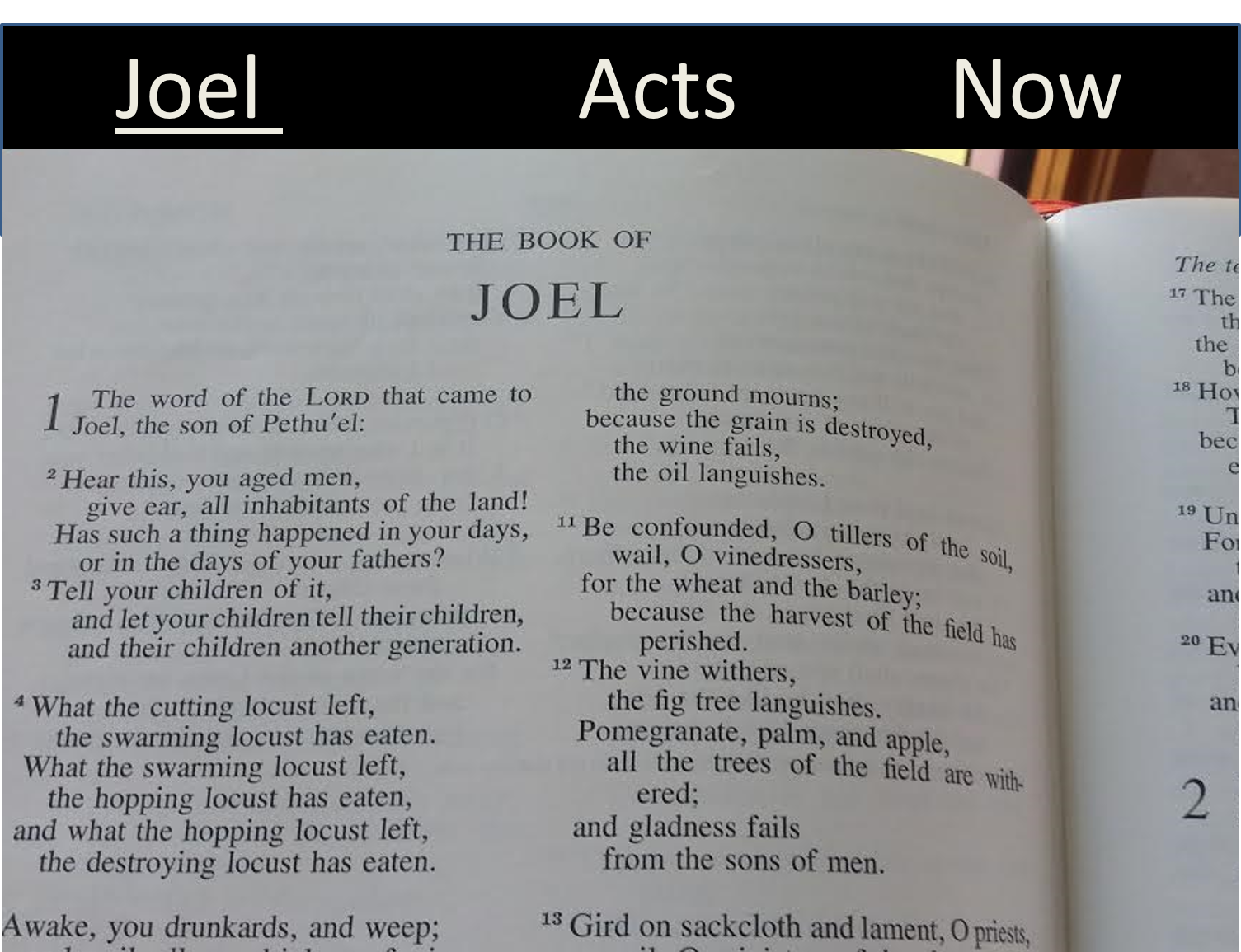
The Promise Fufilled: the Spirit poured out then and then and here and noa (Joel 2:28-32, Acts 2:1-16,40-47)


Since we’ve moved to our new place in Onehunga, Mangere bridge has become a feature in my life. Or I should say the Mangere bridges. The new bridge adds a constant background motorway hum to the soundtrack of our everyday. At night, out our window there is a line of red and white lights arching over the dark stripe where the Manukau Harbour morphs into the Mangere basin.  On days off I’ve gone for a walk across the old Mangere bridge, with its vistas down toward the Manukau heads. Puponga point and the
Awhitu peninsula in the distance. The harbour changing with the weather, from friendly sparkly blue, to moody forbidding grey. As the sun sets there is an array of golds and reds. Even the old cement silo’s become a canvas for the magical play of last light. Having grown up on this side of the Manukau, up in the hills out west, the far side of the bridge has always seemed like a distant shore, another place and it still seems like you are going somewhere else when you walk over the bridge but now exploring both sides helps me understand this city more.


We’ve been looking at the work  of the Holy Spirit in the Old Testament from hovering over the waters in the creation narrative at the beginning of Genesis, through to the promise of the Holy Spirit being poured out on all flesh, in the prophecy in Joel chapter 2. The fulfillment of which came at Pentecost, recorded in our reading from Acts chapter 2 this morning. We’ve been looking at what the Spirit did on the far off then and there shore, & how the life, death and resurrection of Jesus has changed things and what it means for us on this side, here and now.

Joel’s prophecy acts as a great bridge between the then and there and the here and now. Then and there, because it stands at the end of the Old Testament narrative, looking at God’s restoration of Judah and Jerusalem, that started with the return of the exiles from Babylon and stares off at the hope for a greater fulfillment in future times.  Here and Now because it is the passage that Peter uses to explain what was happening to the one hundred and twenty followers of Jesus gathered in that upper room in Jerusalem: that what was promised then was being fulfilled now, God was pouring out his Spirit on all flesh. It stands at the birth of the Church, the reality that we as God’s people live in today.

Today is Pentecost, and I want to go backwards and forwards across that bridge between then and there and here and now so that we may know the reality of that Spirit poured out. I want to focus on three things, the context we find ourselves in, where we are at in God’s story. Secondly to explore the idea of all flesh and to see ourselves in that, and finally to look at what it means that we all prophecy, to be a prophetic people. Then we’ll ties it all together.

Firstly context. 

The book of Joel speaks of Judah facing judgment, locusts and a drought, that judgment is accompanied by a call to repentance, then assurance that after the judgment, God would restore the fortunes of his people and would renew his relationship with them, they would be blessed and the nations around them judged. Scholars are unable to tie Joel down to any historical facts or time, but it was included into the Old Testament cannon because people could see it as God speaking directly to Judah’s journey. Their exile in Babylon and after that of the restoration of Jerusalem, that we see in books like Ezra and Nehemiah, but also looked to greater and fuller restoration and fulfillment to come. Joel Baker sums this journey up in the title of his commentary of Joel “ from the depth of despair and sorrow to the promise of presence”.

The ultimate way in which God has forgiven his people and made a way for them to be reconciled with him is in the life death and resurrection of Jesus Christ. We’ve just spent about a year and a half working our way through Luke’s gospel and one of the ways Jesus talks of his death is as a judgment on the spiritual blindness of the world.  It is Jesus who takes on himself God’s judgment, and enables the restoration of relationship with God through his suffering and death. It is in his resurrection that that new life is made possible. We experience that new life and restoration, the fulfillment of the promise of God’s presence, with a greater fulfillment when Christ returns.  Bakers title could as easily refer to the Easter story ‘from the depth of despair and sorrow of the cross to the promise of presence in the words of the risen Jesus ‘and I am with you till the end of the age” made real at Pentecost.

You and I find ourselves in that story as well. It’s not just history, it’s our story. Once we were far away from God as it says in 1 Peter 2;10 but now we have drawn near. Because of the death and resurrection of Jesus Christ we can know God’s forgiveness for all we have done wrong and we are bought back into a relationship with God, as his children and as his people. In Christ we have been given new life, abundant life. At the centre of that is that God restores his relationship with us by filling us with the Holy Spirit.  Our story is that we have come out of the deep despair and sorrow of life without God to the promise of his presence.

Secondly, “all flesh”

As we’ve seen in our survey of the Old Testament God has worked and spoken through individuals who he has filled with his Holy Spirit. But in this passage, it says he will pour out his Spirit on all flesh. Flesh is used here to distinguish humans, beings of flesh and blood, from God, who is Spirit. And ‘all flesh’ is reinforced in this passage by the language of inclusion. In three statements sex age and socio-economic status are swept aside. Your sons and daughters will prophecy. Old Men will dream, dreams and young men will see visions. Dreams and visions are scriptural ways in which God gives revelation to people. Age is not a barrier. Even on your servants, both men and women. Slaves in Israel were also most probably foreigners, and this is not only speaking about social status not being a barrier but also the possibility of the gentiles being involved. I’m allowed one bad pun a sermon… here it is… It is for all sorts, but seriously it is  for everyone.

In Acts we see all flesh being reinforced by the apostles speaking in all the languages of the people gathered from all the regions of the then known world. Pilgrims who had come to Jerusalem for the festival of Pentecost. It is a prophetic event, Jesus had come and given his life because God so loved the world, he had commissioned his followers to go and make disciples of all nations, they were to be his witnesses in Jerusalem, Judea, Samaria and to the ends of the earth. The Holy Spirit was enabling them empowering them to do that. Symbolized by the speaking in all the different languages of the known world. In Acts 10, when the Gentiles receive the Holy Spirit this sign is repeated to show that ‘all flesh includes the gentile nations as well.

Peter finishes his sermon at Pentecost, by saying this is for you and your children and for those who are far off. Time and place are not a barrier either, it isn’t just for one generation, one place and time, just to get the church growing and off the ground, a bit of start-up capital thrown in by an entrepreneurial God. Not just limited to that place.  It is God’s promise to all of us, to you and I. the language of inclusion is not just used here to fit into some politically correct agenda, it’s the promise of a loving caring God, for all of us.

Lastly, what does it mean that all will prophecy? I mean there are not enough street corners for all of us to stand there wild eyed calling out ‘the end is near’ which maybe the image that comes to mind when you think of that.

Joel chapter 2, does not exist in a vacuum, there is a whole thread in Old Testament scriptures that we need to touch on to understand what is meant. Moses in Number 11:29 says “I wish that all the LORD’s people were prophets and he put his Spirit on them.” The hope that all God’s people would know him as Moses did, and be able to declare his timeless word and purposes in a timely manner.  In Ezekiel and Jeremiah, we see that just as they had been given a scroll of God’s word to eat, there is the promise that God would put his word in people’s minds and hearts, and change their hearts of stone to hearts of flesh. They would be a people whose hearts were filed with God’s grace and love. A motif that runs through the Old Testament is that Israel has a missional task in world history, to live in such a way, caring for the poor and the marginalised, being a beacon of justice and righteousness, that nations would come to see and know and worship Israel’s God. They were to be a prophetic people. The Spirit was going to e poured out on them to enable them to do that.

In Acts, we see this at work as well. All the disciples gathered together are filled with the Holy Spirit and begin praising God. It’s self a prophetic Act declaring the good things God has done.  Peter stands and begins to prophecy, he takes God’s timeless word, from Joel 2, and makes it timely, this is what is happening now. In the New Testament, there are people given gifts and ministry of prophecy, it is their task to speak forth God’s word, but all of us are called to prophecy. Acts 2 finishes with a description of the church in Jerusalem living in a way that declares and witnesses to Jesus Christ. There life is built round, the teaching of the apostles, prayer and the breaking of the bread: these are the means of grace by which we know Jesus more and more and allow that relationship to shape and mould us. They form community and share hospitality. There is a genuine concern for the poor, they sell what they have and give the money to those in need. They care and pray for those who are sick and see God’s healing. AS they do this people come to see Jesus Christ in their midst.

It’s the same for us today. People often equate the whole Holy Spirit thing with chandelier swingers and happy clappys, as pure emotionalism, and can I say why shouldn’t you get excited about knowing God’s very presence and power. But the result of the Holy Spirit’s activity and genuine revivals has always been a hunger for God’s word, an increase in prayer, a renewal of worship, a desire for Christian unity, hospitality, a desire to see people come to know Jesus, genuine signs and wonders but also a seeking of justice and righteousness a care and care for the poor. The Spirit of God is what gives us the Spiritual vitality we need to face and work for peace in the world. It gives us joy and hope in the face of evil and disaster.

This Pentecost as I’ve reread acts chapter two, the thing that really stuck out to me was that the fire that symbolised the Holy Spirit, came and appeared as a tongue of fire above each of the followers gathered there. When we focus on ideas like context and all flesh and being a prophetic people, its easy to get caught up in the big picture, get lost in the crowd. It’s easy to think of the Holy Spirit being poured out on all flesh as kind of like splashes on the masses, like those weather events we’ve had recently, indiscriminate drenching. But the Spirit came upon each individual person, they were not lost in the crowd, each unique person encountered a God who knows them, who loves them, who sent his Son to live die and rise again for them. I just want to say it’s for all of us corporately, which means its for you and I individually.  We started with the image of a bridge that has come to mean something in my life, and we’ve been across the bridge from then and there to here and now in a survey of the Old Testament, but it is for you to be willing to cross that bridge from it being a then and there thing to a here and now reality. To stop and to ask the father to fill us afresh, to fill and keep filling us with his Spirit’s presence.  

Tuesday, May 30, 2017

future Hope for Present times In God's past and persistant faithfulness (Psalm 126, John 16:16-22)


maybe not the negev. But  Areminder that the tide does come in
and cover the manukau mud, that if you are not careful can drag you down.
“History does not pause” says EM Blaiklock, as an introduction to his commentary on Psalm 126, “Every ending is a new beginning.”  He’s talking of the larger stage of world history, as the psalm talks about the restoration of Jerusalem after the exile in Babylon. But it could as easily be on the personal level of the psalmists own story.

“Every ending is a new beginning’ can be a message of hope as we see a phase of life end and a new one bring new possibilities, new adventures. It can be a note of warning, as we face new challenges, problems and issues. You just need to look at the news each evening to see this played out on the grand scale, everyday a new miracle breakthrough to make life better, every day crisis after crisis. Maybe you’ve found yourself saying that well-worn lament, “if it’s not one thing it’s another”. Psalm 126 is a prayer for God’s help in the present, (in verse 4), amidst the concrete past ways God has come to the aid of his people… in "restoring Zion", and a future hope that he will do the same again..." those who sow in tears will reap in joy'.

Scholars are split to the timing of this psalm.

Some see it as a prayer for help in the exile itself. With hindsight the psalmist in their extended exile, looks back at all the times that God had saved his people: Looks back at God’s covenant faithfulness throughout a history of the people’s unfaithfulness. That God had always restored his people, turned their mourning into joy and shown his sovereignty and good works to the nations.  The book of judges and the books of kings, show both Israel’s unfaithfulness, generation after generation, time and time, proof that God was justified in allowing them to be taken into captivity, but also time and time again as they had repented, God had moved to save them. As they sit in exile and one generation passes onto the next they long and dream for God to do what he done in the past for them.

Others see it as coming from after the restoration of Zion, after the remnant of the exiles have come back. God’s amazing hand of grace and mercy at work, it is like it is a dream. But as they have come back, they have found that the reality is far from the expectation. As you read the books of Ezra and Nehemiah you see the challenges before them. A city in ruins an economy in ashes, the place of worship at the centre of who they are desolate and destroyed, and opposition, hostility and suspicion all around them. There were tears in the midst of their joy…

Either way, the psalm looks for help in the present situation, with faith and trust and hope for the future because of God’s faithfulness in the past. The Psalmist looks not only to history but also to the natural world as well. To the south of Jerusalem lies the Negev Desert for most of the year a dry and barren place, seeming lifeless and without hope of things changing, but then the rains come and the wadi’s fill with water and the desert blooms with the vibrant colours of life. If God can do such a wonder in that place, there is hope that as Israel sows in tears, laments over it sins and seeks God in the face of insurmountable problems, there will be a harvest of joy and plenty. The God of history and creation can be trusted.

Psalm 126 is a psalm of ascent, used by pilgrims as they came to worship at the great festivals in Jerusalem, used as they walked up the steps to the temple. It’s a psalm that not only covered Israel’s past but was general and open enough to invite the pilgrim to bring their cares and concerns before God, both as they viewed the world around them, and the distant places they had come from but also the things that were close to their heart’s and drenched in their private tears and deep sorrow. Bringing them with the same trust and the same hope to God. God who was faithful in the past can be trusted to bring new life and joy in the desert, to restore Zion, and to do more than we could possibly dream of today.

Psalm 126, invites you and I to have the same hope the same trust, in the same faithful God as we ask for God’s help in our present world. In the New Testament reading in John 16 we see Jesus tell his disciples that there will be a time when they will not see him and there will be grief but after that they will see him again and there will be joy, joy that the world cannot take away.  He is talking about his death and resurrection, but it can also be about the ongoing Christian walk as well. There are times when it seems we are facing difficulty and hardship, God may seem far away, but we can trust in God’s unfailing love. There is the empty Cross, Christ has paid the price for all we have done wrong and made it possible to come into a new relationship with him. There is the empty tomb and we have the assurance of new life that goes into eternity because Jesus is risen from the grave. This Sunday we celebrate Pentecost and we know the fulfillment of God’s abiding presence with us because he has kept his promise and poured out the Holy Spirit on all who believe. We have a comforter, an advocate, and enabler, one who comes alongside in the Spirit’s presence.

We can see that in the testimony of other pilgrims who have walked before us, the story of the church for the past two thousand years. In our own lives we have experienced the goodness and the forgiveness the with-us-ness and for-us-ness of God, that gives us hope for the future, as we face the present.

Two illustrations to finish .  On the large scale. In 1963 Martin Luther King Jr gave his I have a dream speech, it was very much like the dream at the beginning of this psalm of God’s preferred future of racial harmony and equality for his children’s generation, freedom from the continued shackles of slavery and oppression. A reality that was going to come through the facing of many present and persistent troubles; beatings, setbacks, prison and political posturing. His famous last speech, tired and weary, even then his hope was that he had been to the mountain top and had looked over to the other side and seen the glory of the lord. Future hope in present time because of God’s faithfulness.

On a personal level. Latifah Philips was the lead singer for the band Page CXVI, a group that has reinterpreted hymns for a new generation. On the day here father died of Cancer, looking for solace she sat down at her piano and began playing a song she remembered from her youth “joy”… “I’ve got the Joy, Joy, Joy down in my heart”, I’ve got Joy, Joy, Joy down in my heart” and it comes across as a lament as all the pain and sorrow and grief comes out. But also of the reality of real joy and real hope in what God has done for us in Jesus Christ. If you google Joy it’s on youtube… It's a declaration of sowing in tears and reaping in joy, of hope because of God’s faithful unfailing love. In that present dark reality in her blog about this song she says

 “it was not until grief became a part of my story that I realized that joy
is not simply an expression, but an attitude and acknowledgment of the
deep peace of knowing a Savior.”

… Joy even when it seems and feels impossible”

May you find hope for the future in your present reality by knowing the faithful one Jesus Christ, and trusting that ‘ he has done great things for them, and he has done great things for us’.


Sunday, May 28, 2017

Putting our hand in the hand of God at work in the world (Daniel 5, John 20:21-23)


Banksy is probably the world’s best known, unknown, graffiti artist. His works are displayed on the walls of public spaces all over the world. they are preserved, treasured, photographed and pondered by thousands. They are collected and displayed in the most prestigious art galleries. They are worth copious amounts of money. But his identity remains a secret.

His work is satirical and poignant and critiques the world in which we live. This Banksy was painted on a wall of a Bristol Youth centre. It’s called ‘mobile lovers’ and challenges the addiction society has to mobile phones, and how that impacts on the face to face relationships we have. Are we present in the moment or is it a moment simply to be presented on social media and lived out or even missed out upon, captivated by cyber space?

  I’m not sure of the impact that Banksy has, whether his art has the power to initiate change.  But writing on walls has been a way in which unrest, disagreement and opposition to political powers and oppression have been expressed for ages. In the passage that we are looking at today it is how God chooses to speak judgement to Belshazzar, the last ruler of Babylon. It is a wonderfully visual demonstration of the Hand of God at work in human history: that the affirmation of the book of Daniel that God is in control amidst the rise and fall of empires and the whirl and swirl of history is true.

We are working our way through a whirlwind survey of the work of the Holy Spirit in the Scriptures of the Old Testament. Moving from hovering over the waters in the Genesis creation narrative, through to the Spirit being poured out on all believers in the fulfilment of the prophecy in Joel chapter two at Pentecost. We are looking at what went on then and there, and through the life death and resurrection of Jesus Christ, what it means for us today. In Daniel chapter 5 we see the Spirit of God at work on the big scale, the big canvas of world powers. But also, how the Spirit filled believer is part of, and connected to that work of the Holy Spirit. We see that in the character of Daniel, who interprets the mystical words written on the wall by a finger… Again the hand of God and the finger of God are ways of talking of the Holy Spirit.

The book of Daniel is set in the time of the exile in Babylon, Daniel is amongst the children taken by king Nebuchadnezzar to train up and work in the civil service of the empire. Daniel is portrayed as one of the heroes of the faith in that setting. Despite the pressure to confirm to his new surroundings Daniel and his friends keep their faith, because of that they epitomise all the characterises of someone filled with God’s Spirit. They have wisdom, God has given them gifts, like the ability to interpret dreams, like Joseph in Genesis. Because of that they are promoted and given important roles.

 The real hero of the book of Daniel however is Israel’s God, who despite his people being beaten by the Babylonian army is still the sovereign all powerful God, in control of the flow of human history. In the dreams and visions that Daniel has of statues and strange and ferocious beasts coming out of the water, we see that history is moving towards a time when God himself will establish his Kingdom. The visions and dreams of Daniel point us to the coming of the one like a son of man, who we know as Jesus Christ. In Daniel and his friends being divinely delivered by God from fiery furnaces and lions dens we see the sovereignty of God to defend his people. In chapters four and five, which we are looking at today, we see that it is Israel’s God who speaks to the lives of, and is sovereign over the powerful world leaders of the day.

Daniel chapter five is set in a drunken party thrown by Belshazzar for a thousand of his nobles. During it he calls for the gold and silver goblets that king Nebuchadnezzar had taken from the temple in Jerusalem and uses them both for drinking and toasting the God’s of silver, gold, bronze and wood and stone. Belshazzar is a difficult figure to track down in history, what we know of Babylon after Nebuchadnezzar’s death is a series of short lived kings, culminating in someone outside Nebuchadnezzar’s family taking the throne, Nebonidus whose son, Belshazzar, ruled in his place whien he was absent for 10 years from the city. As the party goes on a finger appears and writes on the wall, causing Belshazzar to be full of fear.

Belshazzar asks all his magicians and sorcerers and wise men to explain the words and they cannot. Then we have the queen which is probably, the wife of Nebuchadnezzar, tell him of Daniel being filled with the Spirit of the gods, and having the wisdom to understand such things. The queen is very much a Babylonian and so she couches the understanding of Daniel being filled with the Holy Spirit in very pagan, polytheistic ways. Belshazzar calls for Daniel, and in a very dismissive, derogatory way asks this ’mere captive’ to tell him what these words mean. Which Daniel proceeds to do.

AS Daniel speaks he contrasts Belshazzar to his predecessor Nebuchadnezzar. Nebuchadnezzar, had ruled with some wisdom and had respected the religious objects he’d bought back from Jerusalem, objects that were set aside for worship and not for common use. Belshazzar had no such respect, this was sacrilege using these cups to worship the God’s of material things.  Nebuchadnezzar, had had a dream which Daniel had interpreted for him, God had spoken to him about his own pride and arrogance, thinking he was the ruler of it all, not simply ruling because the sovereign God had allowed it.  Nebuchadnezzar had heeded the dream and then one day forgot it and had ended up with a mental illness that meant not only did he loose his throne, but ended up living like a wild animal. When he come to his senses and was restored to his previous position, he also started reforms in the empire for just and righteous treatment of people. Daniel chapter four is unique in Old Testament scripture, it is written in Aramaic not Hebrew and it is basically Nebuchadnezzar telling his story, giving his testimony that through that process he now believes in the God of Israel.  Belshazzar had no such humility and had not heeded that story. So God was going to judge him.

The words on the wall are Mene, Mene, Tekel, Parsin, they are weight measurements and amounts of money, going from a high amount to a lesser one, and Daniel says it means, numbered weighted divided. Belshazzar’s days as ruler are numbered, he has been weighed and found wanting; the kingdom of Babylon under his rule had fallen so much, not ruled with wisdom and justice but rather by one who is totally consumed with what’s in it for me, carnal pleasure and material prosperity. Divided, because he would be overthrown and Babylon divided amongst the Medes and the Persians. Which happens that very night as the city is easily conquered by Darius the Mede, the general of King Cyrus of Persia. Belshazzar is killed.

In this story we see God moving in history. Both in the case of Nebuchadnezzar and Belshazzar. In Daniel chapter 4, where Nebuchadnezzar, responds to God’s warning and judgement and repents of his pride and changes. In chapter 5 Belshazzar does not repent and so faces God’s judgement. In both cases Daniel is the one who speaks God’s word, as we saw in the call of Ezekiel last week whether it is listened to or not. Daniel speaks to Nebuchadnezzar with more grace and hope than he does to Belshazzar, whom he does not readily give the chance to repent, maybe because Belshazzar has not been willing to heed history and has not even been humble enough to seek God’s advice through Daniel. In the Old Testament, God gives dreams and visions to non-believers but it is the representatives of his people who have the presence of the Holy Spirit who are needed to give people understanding, who are used to speak God’s word clearly into those situations.

So what does all this have to say to us today.

The first is that God is at work through the Holy Spirit in human history. We can think the world is out of control, on some frenzied aimless dance through time, But God is in control, history is moving towards a conclusion, God is working his plans for good and not harm. Daniel shows that in that the whole book points to the coming of the Kingdom of God in Jesus Christ. World history is changed by his coming, his death and his resurrection. We as God’s people are called to have trust and faith in God’s power and presence. It may seem like evil triumphs but in the long view of God’s divine justice this is not the case.

Daniel gives us indicators of how we should live in the light of that truth. We see him faithfully keeping his faith. The only way his enemies can come up with to get rid of him is to make it illegal for people to pray to their own God under king Darius. His spiritual practises of Prayer and meditation are what keeps him focused and going, trusting and serving, and he will not stop them for anything. That is how he ends up in the Lion’s den.

Also we see Daniel prepared to keep on serving and working in the place where he finds himself. When he is called upon to speak, he speaks God’s truth trusting in the presence and power of the Holy Spirit to enable him to do it. He can speak with authority and knowledge. Theologian Karl Barth instructed people to read their Bibles and newspapers side by side, and to interpret the newspaper by what they read in the bible. Maybe in today’s world we need to read our bibles on our phones side by side with newsfeeds. It is easy to perhaps to do it the other way round and let what we see in the headlines interpret what we read in the scripture… making it nothing more than old wisdom being pushed to fit the agenda of this world rather than shine the light of God’s Kingdom into this world. We need the spirits help and presence, leading and guidance to do that.

In our New Testament reading from John’s gospel, we also have Jesus teaching on the presence of the Holy Spirit. Jesus breaths on his disciples and sends them out into the world, just as the father has sent Jesus, to bring the kingdom of God. he gives them his Holy Spirit to do this. Jesus outlines our mission as to forgive people their sins. It is about calling people to turn from their own ways towards God’s ways Just as Daniel had done with Nebuchadnezzar, but the challenge is that if we do not forgive people they will not be forgiven. As 2 Corinthians 5:19-20 says, we are called to the ministry of the message of reconciliation with God, as ambassadors of Christ. Sometimes like with Belshazzar in Daniel 5 that message is one of judgement, I the hope that people will respond and know God’s grace. We are always called to speak God’s timeless word and truth in a timely manner, and the spirit enables us to do that. 

Missio Dei or the mission of God is a term used to tie the working of God in our world together with how we live as the Church. God’s work in the world has always being sending, the father sends the son and the father and son send the Spirit. And as we read in John 20 the father also sends us, the mission we are called to as a church is to see what the spirit is doing in the world and go and join in. With God’s grace, and trust and justice. To be carriers of God’s mercy and love, forgiveness and peace.  Historially you can see it in the revivals of England under the John Wesley and others leading not only to a renewal of people’s faith, but leading directly to the enlightenment, the abolition of slavery, the reform of prisons, child labour laws, the establishment of the RSPCA, a desire for universal education and literacy. Renewed personal and communal spiritual vitality resulting in systemic change and transformation. In fact one commentator said that the Wesleyan revival and its impact stopped England from the same bloody revolution that France went through. The way in which the church in the west finds itself pushed out of a position of power and influence at the centre of society is also showing us that the Kingdom of God lies at the edge of society, in caring for the poor, the prisoner, the sick and hurt, disadvantaged and powerless, that is where it can see the Spirit bring the most change and transformation. It’s at the edges of society as we are called to be one people across so many diverse cultures and nationalities, very much like the first century church, where at Pentecost people heard them speaking in their own languages from all over the world. In a world once again that worships material wealth and sees success in terms of what we have, that there is more to life, fulfilment is found in knowing God and sharing what we have as the Spirit leads. As the world sees us doing that it will again seek out what we have to say: the gospel of Jesus Christ. As the world sees that written in our lives not stencilled on a wall, when we are more Christ like (or Christy) rather than Banksy will we see the kingdom of God made known: As we entrust our hands into the hand of God moving in the world.

Wednesday, May 24, 2017

God in control of this out of control world of ours... A prayer of thanksgiving and confession and communal lament and affirmation of trust


I've been preaching my way through the psalms of ascent at a retirement village and in Psalm 124 and 125 we looked at Communal laments. Looking at how on a personal and societal level things are not at all good. One of the amazing things about these communal laments is that they contain some of the strongest affirmations of faith and hope in God... Lament goes along with trust. 

This week I'm preaching on Daniel chapter 5 which is a passage about the spirit moving in world history. It is again a passage that deals with the worst of human sacrilege and the decline and decay of empire, and in the middle of that God's sovereign hand, offering last minute grace but also changing empire. In the middle of that Daniel is faithful and willing to move and be where the Spirit moves... In my own inadequate way I've tried to tie this all together in a prayer for the service this Sunday... In the face of terror attacks at a concert in Manchester, continued civil war in Syria, famine in eat Africa, North Korean missile tests and the seeming swirl and whirl of political change.

The affirmation of the prayers of ascent and Daniel are that God is in control. That we are called to live out our transformative faith in Jesus Christ amidst this with the ministry of reconciliation, humble service and selfless love   of Jesus Christ in the power of the Holy Spirit.


It would be easy to find ourselves shaken to the core,

Distort and full of despair as we see what is happening around us

Bomb blasts murder teenagers and children die in civil war

Famine and conflict join hands to kill with hunger’s cruel grip

The dangerous bravado of sabre rattling with nuclear tipped missiles

The unsettling swing of ideology, and polarizing, politics of popularity  

Amidst the wrestle to know truth from well-constructed fake,  

Lurching from crisis to crisis, climate change and super bug

It is easy to wonder where it’s all going, spinning out of control


But amidst histories crazed forward dance

We stop and proclaim God’s hand is at work

The sovereign Lord, creator of all, is in control

Working his purposes by the Holy Spirit, in this world

Calling his people to follow Christ and to reconcile

Amidst it all God has sent his Son, his kingdom has come

Not in the clash of army or over whelming force

But in humble service and sacrificial love

In Jesus life, death and resurrection


God is at work, his plans for good and not for harm

His desire for people to be forgiven and made whole,

For justice and righteousness to flow

For those whom he has called and made his own

To see what the Spirit is doing and join right in

To be peace makers and Christ light bearers

To love one another as Christ has loved us

Witnesses to the hope and good news of Jesus Christ

Living as Kingdom of God citizens in the realms of this world


Righteous and Holy, God

The one who rules above the storm,

We give you praise for who you are, both sovereign and loving

We declare your goodness and grace that has bought us life

We pray for your forgiveness, for wrong done and good left undone

We thank you that in Christ the slate is wiped clean

We pray for the renewing presence of your spirit

That we might be your people, and do your will  

That we may live, and speak and act to your glory


Amen