Tuesday, June 15, 2021

One gift for all ( Acts 2) A pentecost message


A Message which was preached at the combined service of HopeWhangarei at Pentecost. A large part of this message is a reworking of an older sermon... 

here is the link to an audio recording of this message 

 https://anchor.fm/hope-whangarei/episodes/23-5-21-Howard-Carter---One-Gift-For-All-e11d9qt/a-a5lbfi7 


Today we celebrate Pentecost, A Jewish harvest festival but also the time when as the Church we celebrate the coming of the third person of the trinity, the Holy Spirit on those first believers on what is often called the birthday of the Church. What we want to look at today is the fact that God has given all who believe in Christ a gift. The gift of the Holy Spirit to dwell with in us and fill us with the presence of God. You see you and I are God’s spirited people. The very presence of God dwells within us. I love stain glass window art. I really like the dove in this window over here, which is a symbol of the Holy Spirit, from the gospel narrative where at Jesus baptism it tells us the spirit descended on Jesus in the form of a dove.  I love the way the light shines through that window in the late afternoon and puts this wonderful kaleidoscope into the body of the church. The spirit of God poured out on us all, on all who believe in Christ.

 Over the period between Easter and Pentecost we’ve been working our way through a series looking at the gifts of the Holy Spirit in the Bible and the Church Today. The gifts of the Holy Spirit are the ways in which God is present with us to empower us and enable us and equip us as the church to bear witness to Christ through word and deed in the world.  We did that by looking at the passages in the Epistles which have a list of Gifts of the Holy Spirit. Each list different and each list telling us something about the purpose and use of the gifts. No list definitive but showing us the breadth of God’s gracious enabling of his people. Not shopping lists or wish lists of things that could make us appear more spiritual but to be humbly used for the benefit of all.  We looked at Romans 12 and saw that all the different Gifts were given so that we could effectively serve God and love one another, many gifts one service, in 1 Corinthians 12 we saw two list of the gifts and saw that while there were many Gifts they were given by the same spirit, they were he way in which God was able to act and speak to and through his people,  Then we saw in the second half of that chapter that there were many gifts but one body, we are all given different gifts and they are to be used together for the common good. In 1 Corinthians 14 we saw that these gifts were to be used in love to build up the church, and given some practical love soaked guidelines for their use in public worship.  In Ephesians four we saw that God had given ministry gifts apostles, prophets, evangelists, and teachers and pastors so that the church could grow into maturity in Christ, lacking in nothing and being about the kingdom of God. In 1 Peter 4 we were encouraged to use these gifts more and more for the glory of God.

sometimes I think that our understanding of the Holy Spirit and the gifts the Spirit gives is like one of the stain glass windows at St John’s in Rotorua, where I worked. The gifts of the gifts of the Holy Spirit were represented by triangles of different coloured glass in the windows at the top of the church. The sun was supposed to shine through the upper windows and through the glass triangles and down on to the congregation, symbolising that the Gifts the Holy Spirit were for everyone, not just what was happening up the front. The problem as that the sun never shone through on a sufficient angle for that to happen. There was a disconnect between them and the congregation, which I felt was symbolic for a lot of us of a disconnect between the gift of the Holy Spirit and the gifts of the Holy Spirit and our own lives. What I want to do today is use Acts 2 as a way of addressing a lot of the issues around that disconnect. I want to do it in a very 21st century way.  If you go on to websites you’ll often see a FAQ page or frequently asked questions page and I want to provide us with that today.


Let’s have a quick look at Acts 2 first. It is the story of the coming of the Holy Spirit as promised and the start of the mission of the church as witnesses to Jesus. Basically it is split into three parts. the first details the events that took place as the spirit came upon those first believers gathered together.  It outlines what happened and peoples response. The central part of the narrative is Peter’s sermon where he explains what is happening and preaches about Jesus. The third section of the narrative is the peoples response, about three thousand were saved and then a concluding description of how this new community, God’s Spirited people, lived together being lead and empowered by the Holy Spirit.


The first frequently asked question is ‘Do all Christians need to be filled with the Holy Spirit? Is the Holy Spirit for every one or just the certain chosen few? Is it essential or is just an optional extra like leather upholstery and racing strips on a car?

While we’ve been addressing that throughout this series, it is good to look at it again. The answer is yes it is for everyone. Look at the flow of things in Acts 2 it starts by says all the believers were gathered together (About 120), all of them were filled with the Holy Spirit, men and women, in this case all of them spoke in tongues. When the crowd gathers it is the apostles, Peter and the elven that stand up to speak, that is the gift that they have been given, so they use it. They have been training for this moment with Jesus, the narrative ends with people living in a way that reflects the Holy Spirit’s presence in their midst, in all of them with the love they have for each other.

The other important answer to this question comes from the passage that Peter quotes from the prophet Joel, that he says is being fulfilled that day. That God would put out his spirit on all people, and it is a comprehensive list… men and women, regardless of socio-economic status ‘on your men servants and women servants as well, all would speak God’s word or prophesy… and regardless of age… young would see visions and old would dream dreams, and you can choose for yourself which category you are in. 

 WE are all to be filled with God’s Holy Spirit. As Paul says ‘ he anointed us, set his seal of ownership on us, and put his Spirit in our hearts as a deposit, guaranteeing what is to come.’ 2 Corinthians 1:22

The second FAQ is ‘was it just for the people then, just to get the church kick started you know and it’s not for us today. I mean we have the New Testament?’… when it comes to the gifts of the Holy Spirit the church is split along those lines, those who believe the gifts of the Holy Spirit were for then and there but they’ve stopped now and those who believe that it is for all people at all times.

Focusing on what we have read to us today, Peter finishes his sermon by saying that those who repent and believe in Jesus will receive the gift of the Holy Spirit. That it is a promise for you and your children and for all who are far off- for all whom the Lord our God will call.’ Some have seen this as saying it’s for the first couple of generations of Christians, which is a literal interpretation, but it is more likely a way of talking about it being for all generations to come. For all who God shall call.

People who talk of the gifts not being for today often point to the second half of 1 Corinthians 13 where Paul talks of tongues ceasing and prophecy ending… when the perfect comes. They see that as meaning the New Testament scriptures. It is hard to write back into Paul in one of the earliest letters which is included in the New Testament canon that he would see a time when we had such a collection.  He was writing to a church that had people who believed that the kingdom of God had come in its entirety and they were like heavenly spiritual beings and he has to remind them that this is not the case; they are to look forward to a greater fulfilment when Christ returns.

The fullness of the Holy Spirit, its presence and the gifts are for us today.

Another FAQ is … when you talk about the Holy Spirit we are bit worried you mean all the weird and wonderful stuff that seems to go along with it at ‘those churches’. do we have to become like them?

In Acts 2 there are very real manifestations that go along with the coming of the Holy Spirit. The wind, the tongues of fire everyone speaking in languages of all the nations gathered on that day. This was an important event an epoch changing event. The wind and the fire are symbols of the Holy Spirit from the Old Testament, the speaking in a language that all could understand was   a sign that this was God pouring out his spirit so that the people of God could and would witness to all the nations of the world, this was the revolution of God grace for all, so it was appropriate. We do tend to forget that the focus of the narrative is on what happened to God’s people and we see they had boldness to preach about Jesus. The majority of this passage is about peter explaining the scriptures and pointing people to Christ. The other thing is that it ends with a summary of the life of God’s Spirited people in Jerusalem.  The signs of the presence and moving of God’s holy Spirit are not really all the weird and wonderful stuff, but people repenting and turning to God, a hunger for God’s word, an increase in a dedication to worship and prayer, unity and love; shown in generosity and hospitality, a genuine and practical concern for the poor, a renewed passion for people to come to know Christ, and yes that God does move in signs and wonders.

I think we’ve just gotten to a point where we are not used to God being God in our midst… in one edition of the voice of martyrs magazine, one Syrian pastor who has stayed in Syria during the war there, talks of the church being full, and many Muslims coming to faith 80-90% of them because they have had a vision or a dream… one man asked to become a Christian after a dream where he was drowning in a river and a man came along and hauled him out, he wanted to become a Christian because he just knew it was Jesus… Closer to home.. My Mum, who was about seventy at the time,  shared a vision she had in church one day, she was in vast fields of the most beautiful wild flowers, and she saw a man in the middle of them, that she just knew was Jesus, and he looked at her and said, ‘I know all these by name’. Affirmation that we are all known. But can I say that the most common thing I experience when I pray for people to be filled with the Holy Spirit is an overwhelming sense of God’s peace and love, which I think is the most amazing and awesome thing… God presences himself with his people as he has promised. Christ is with us to the end of the age as he said he would be.

Ok let’s move on our next FAQ is ‘Is being filled with the Holy Spirit a one off experience that you need to be prayed for to receive or is it an ongoing day to day relationship?”  

In Acts chapter 2 it is a new experience a new encounter with God. We don’t know what the experience of the three thousand who came to faith that day. There are others like that in Acts, when the gentiles receive the spirit in acts 10, and throughout history as well times when God has met people and poured out his Holy Spirit in a new and fresh way, the Pentecostal movement, look back to the Azuza street revival in 1906 as the place where the renewal of the gifts of the Holy Spirit happened for them. You could look at the welsh revival… there have been times of great revival and outpouring of the spirit in our own Presbyterian Church as well. In fact one church historian talks of the Presbyterian Church being born in the fires of revival. However We receive the Holy Spirit when we become followers of Jesus Christ. It is what brings transformation God comes and dwells within us. Paul talks of walking with the Holy Spirit, an ongoing day to day encounter with God through the Holy Spirit as the way in which the Christ-like fruit of the Holy Spirit are produced in us. Even when he says ‘be filled with the Holy Spirit, in the Greek it is in a tense which means be filled and keep on being filled by the Holy Spirit.

Perhaps it’s best to leave the last word on that to Jesus. We are so used to his words on Prayer ‘ask and it will be given, knock and it will be opened, seek and you will find’ that we forget that it finishes in Luke’s gospel by saying ’How much more will God give the Holy Spirit to those who ask him’. When we pray for people to be filled with the Holy Spirit it is that we want them to know that presence more and more and have their lives filled more and more by God’s presence. When that happens in our own prayer life or in a meeting or gathering, it is God’s good grace to give it to us. In fact when we pray for that it is not the manifestations that happen that are the important thing But that we can trust God keeps his promise.

So I think the answer is yes, it can be an experience and it is an on going relationship, ask and you will receive. Keep on asking and receiving…

Lastly ‘How may I be filled with the Holy Spirit?’

The answer is that if you love Jesus Christ then Ask and you will receive. AS we’ve looked at the scriptures the amazing thing about the New Testament is that because of what Christ has done for us , God wants to live in us, God wants to fill us with his presence by the Holy Spirit, it’s simply a matter of asking him and believing that he will do what he has promised.  God will give us a fresh touch of his love, empower us to witness for him, fill us so much with his presence and reveal his word to us that it will flow out of us. WE will be so filled with God’s love and presence and joy that our vision of what is and what should be will be shaped by that, our dreams filled and directed by Christ. Our actions and reactions become more and more Christ-like, more and more Spirit enabled and gifted, and Christ’s vision of the Kingdom of God will be our vision.


When I was preparing for this message I came across a white dove in the guttering of the Church. Sitting right above the stain glass window there. They fly round the street here all the time. Maybe we are happy with the Spirit out there, but God wants to pour out his spirit more and more on his people on us so we will know his presence and  to enable us to live and witness to him in the world he loves.

 I’m handing back to Lorne now and we are going to respond to what we’ve heard by bringing our tithes and offering to God, and praying for the world. Then I am going to lead us in a prayer for ll off us. That we may be filled afresh with god’s Holy Spirit, to enable us to live as God’s spirited people in this world and to be about Christ’s mission in the world he loves. All of us. 

Wednesday, June 9, 2021

Many Gifts, One Spirit in Public Worship (1 Corinthians 14:1-40)


I'm catching up with putting sermons on my blog...This is part of a series  preached at HopeWhangarei between Easter and Pentecost on 'the gifts of the Holy Spirit' looking at the passages in the Pauline epistles that have lists of the gifts.


here is a link to an audio of the sermon https://anchor.fm/hope-whangarei/episodes/2-5-21-Howard-Carter---The-gift-of-the-spirit-in-public-worship-e102hm9/a-a5eapul 

here is the written script (which differes from the spoken version...)

The first time I heard the gift of tongues used was in an evening service at the Church I grew up in at Titirangi, way back in the 1970’s. It happened in a very Presbyterian way. In a quite time after the worship songs set aside for the use of the gifts, an elder in our church said he believed God had a message for us in tongues. He then spoke that message out. A woman elder on the other side of the church then gave a message in English. The minister who was running the service asked if the first elder felt that was the interpretation. Which the elder, said yes he did. Then the wife of another of our elders spoke up and said she had been a teacher in Tonga for over three years and while the language was not Tongan, it was a pacific language and she recognised many of the words as sinmilar, which she said appeared in the right positions for her to agree that it was an interpretation. It was a message of encouragement for the church. It was intelligible, in order, weighed by the Congregation and it built up the church. It fits into Paul’s teaching in the passage that we had read us today from 1 Corinthians. A passage about the use of gifts of the spirit in public worship. A difficult passage and one which has been used and in some cases misused to justify different practices in different churches.

Between Easter and Pentecost we are looking at the Gifts of the Holy Spirit, we are doing that by working our way through the passages in the epistles which have lists of gifts; Romans 12, Ephesians 4, 1 Peter 4 and 1 Corinthians 12, 13 &14. Hopefully as we do that, we will be encouraged as a church to use the gifts that God has given us and be more open to the Spirit’s presence and activity in our midst. We are God’s Spirited people he has equipped us and empowered us to embody Christ together in the world.

The passage that we had read today focuses on two gifts, tongues and prophesy, and very practical ways in which they are to be used and why. It is the conclusion of Pauls teaching on gifts to the Church in Corinth.  A church where there seemed to be an overemphasis on the gift of tongues, as a sign of having arrived spiritually. Where this gift seems to have been used in a chaotic way, with no consideration for other people. Before he deals with this practical day to day stuff in the preceding chapters Paul had gone back to look at some first principles. That there were many gifts and they were given by the same spirit, Enosa spoke on that a couple of weeks ago. That there were many gifts but one body, we belonged together and the gifts were given to use in unity and equality for the common good. Which I spoke on last week. Then he focused on the most important thing: the way of love. In my daily devotions this week 1 Corinthians 13 came up and Adrian Plass commented that we need to focus on love and realize that the gifts were like helpful pots and pans in the Christian kitchen. Utensils that enabled us to love one another. 

Paul’s teaching here starts by reinforcing for his listeners that they should follow the way of love. The sign of Christian maturity was not spiritual gifts, not speaking in tongues, but love for one another. He reiterates the fact that people should seek the gift of prophecy. Speaking God’s word in a timely manner. Then he reinforces that by comparing tongues and prophecy and their uses, particularly in public worship.  Tongues unless it is with interpretation seems to be for personal private use, prophecy is a gift to use in public worship.

In verses 1-5 he articulates the fact that speaking in tongues simply edifies the one who is speaking while prophecy edifies the body: It strengthens, encourages and brings comfort. Paul actually wishes everyone spoke in tongues because it is of personal benefit, but he would rather everyone focused on Prophecy and spoke God’s word because it builds up others. Tongues becomes prophecy and can edify the body when it is interpreted.

Then in v6-12 Paul backs this up by saying that it is important that the words being brought in public worship are intelligible. They can be understand. As the clear use of the gifts is to bring revelation, or knowledge or prophecy or instruction. What good is it if no one knows what is said. Last week as part of our service we commemorated ANZAC day and Phil Cullen played last post and reveille for us. It sturred our hearts because we know the meaning of those calls. Paul uses that sort of illustration here to bring this idea of intelligibility home to the church. What good is a bugler that does not know the signals and the calls? It’s just noise, You could imagine an army in disarray trying to answer the bugle call.  What good is a harp player Paul says that does not know the tune? Maybe here is an echo of his words in 1 Corinthians 13 about gifts being used without love, they are a clanging gong. Even Prophesy needs to be intelligible. In pagan worship and temples, oracles would bring words from the diety they served, but usually they were vague and mysterious and obscure, A sign that they did not come from the living God. The church in Corinth needed to know the difference.

In v.13-18, Paul continues to talk about tongues as being a person’s spirit praying or singing. In Romans 8:26-27 Paul had said in our weakness the Spirit intercedes for us in groans to deep for words. Tongues as a prayer language fits that it enables us to cry out to God from the depth of our being. Likewise Paul speaks of singing in tongues, that he is praising God from his very spirit. Often this passage is used to justify time of singing in tongues in a service. However again Paul goes on to say that in public he wants to pray with his mind as well as his spirit. When he gives thanks to God he wants people to be able to say Amen. To agree and see the wonder and greatness and goodness of God. Everyone else kind of finds themselves in this situation of feeling like an idiot they don’t understand. By the way the word Idiot is used in the Greek here, and it means the uninitiated, those not in the know. Paul finishes this section by saying he speaks in tongues more than any of them, he is affirming it as a gift, and this would have actually shocked the church at Corinth who saw Paul as rather unspiritual. But in Public worship he would rather speak 5 words that were understood than ten thousand that were not.

There is a stage in the development of infants and children as they are starting to learn to speak that they learn to make sounds, and Paul starts his next section by saying the Corinthians are like that they think they’ve got it when all they are doing is go go-ing. He follows that up by quoting the book of Isaiah where it says that even if the people were to be spoken to in a foreign language that there would not turn and repent.

Then in verse 22-25 he speaks about the impact of the gifts of the Spirit on non-believers. He says that tongues is a sign for unbelievers. That has been interpreted in many ways as a positive thing. In Acts 2 it is a sign that the gospel and the promise of the Holy Spirit is for all people. But again notice there that the people heard everyone speaking in their own language. Here Paul says for the unbeliever or the inquirer about the Christian faith, they come in and everyone is speaking in tongues it is a sign that they are all mad. However if they come in and the word of God is being proclaimed and spoken then they will be convicted of their sin and come to repentance. They will turn to worship God. I remember Jim Wallace, my senior pastor at St john’s in Rotorua told the story of man who came to the Lord. Jim had met him at a party and the man had said ‘I don’t need God, I have everything I could want. I’m alright’. Jim felt the spirit say ask him why he sleeps with a gun under his pillow. Which Jim did and the man turned white and asked how did he know that. Well soon after the man came to Christ. Good use of the word of knowledge.

Then at verse 26 Paul turns to start telling people about how to act in worship. That it needed to be in an organised manner. People prepared things and bought it to worship. if tongues were to used there needed to be someone who could interpret there. Then only two or at the most three.  Even with prophesy there should only be two or three at the most speak. Then they should only speak once and not interrupt each other. In pagan worship people would  speak weird words etc as they were caught up in mainic behaviour, where they had worked themselves up to a certain fever pitch. Not so with you says Paul, the Holy Spirit does not possess or override people. Rather the spirit of the prophet is subject to the prophet. The Holy Spirit is gentle. So people need to do things in Order. Public worship should reflect the character of God which is peace not disorder.

Then he finishes it off by giving some instruction about women in worship. In June we will start a series on women in the Bible and my contribution will be looking at challenging passages like this one in v.34-35, which are often called the silencing verses. Because I believe they have been wrongly used in the past to stop women from taking their place in leadership in the church.

  He lets people know that the instructions he is given are the same for all the other Churches. And reiterates his main point. Seek the more useful gift of prophecy and do not forbid speaking in tongues. But remember to do all these things in Order.

So what does that means for us today?

Firstly, this whole series is to encourage us to use the gifts God has given us and this passage gives us some very good insights and guidelines about their use in public worship. In fact this really is some of the only teaching on public worship that we have in the New Testament. As I said before it has been used down through the ages in many different ways. Traditionally brethren and Quakers would worship by being silent until someone was ‘moved by the spirit to sing or to speak. It was organised behind the scenes. Pentecostal and charismatics have seen it as encouraging things like speaking and singing in tongues, but in a way that is in order. That it opens the door for people to bring words, that prophecy is a more spontaneous occurrence. Traditionally reformed people and other denominations, Presbyterians are reformed, have seen that prophecy and people brining their gifts to worship means that they prepare them before hand and bring them to build up the whole Church. Those bringing prophecy are seen as the people set aside for the study and preaching of the word.  Preaching is hopefully prophetic, making the timeless word of God timely. God is more likely to speak to us in the hours put into studying the word and weighing words for a sermon. It strengthens, encourages, reveals, instructs, points to what God is doing. They are all ways that this passage has been applied.

SECONDLY, There is this tension between those who want the more spontaneous and those who want the more thought out. One of the things that the rediscovery of the gifts of the Spirit has meant is that more people are actively involved in public worship. Which is great… It’s what we are trying to encourage here.. I think there has been a pendulum swing also between the spontaneous understanding and the more planned and organised understanding of this passage. We need to embrace both… To let God speak through the well thought out and the sense of speaking to us now.

Likewise we have a tension between people who want to focus on the more spirit idea of worship, emotion and feeling the presence of God and those who want a more cerebral thinking worship. There has been a pendulum swing between those two things. The age of enlightenment, where to worship was a matter of thinking, the Romantic Movement where anthems stirred the very soul, that is where our hymns come from, there was a rediscovery of wanting to be up-lifted in song.  The charismatic movement, with an emphasis on songs that connected with the heart… on personal expression of praise and worship, more than corporate. Even being chant like, you know all that repetition so people could forget about the words and just concentrate on God. At the same time the other large movement in the church was a new liturgical movement where we rediscover the power of words and well thought out prayers and reflections and neo-hymns.  Personally I like both extremes and find myself wanting to embrace the best of all parts of the spectrum if it will build up the church. 

In the end Paul’s words are as real and as important and relevant to us all today.  The key is the way of love. Christian maturity is that we are able to love one another. Love one another across the same kind of issues the Corinthians had. Because we too can fall in to the trap of seeing this way of worship, that we understanding of the way gifts are to be used in public worship as the more spiritual way.  That God only moves and speaks in the way we prefer. Like the Corinthians  need to seek to allow Gods word to be at the centre of all we do, so it may be told forth and strengthen and instruct and convict and reveal and even forthtell, point us to the future. We all need to seek the gifts that will be of more use to building up the Church, not denigrating or writing any of them off. In public worship that they are used in a way that   promotes peace and in an orderly way. So we can lovingly work together to build up the church to the glory of God.

Tuesday, June 8, 2021

Women in Leadership in the New testament: the silent witnesses and the silencing passages (part 1) the silent witnesses (mark 16:1-8, Romans 16:1-15)


This winter at HopeWhangarei we are preaching a sermon series called her Story, Her Voice: women in the Bible. explore the stories of women in the bible and what they have to say to us today. using their inspirational stories and allowing them to speak to us and inspire and encourage us in our Christian walk.

my contribution to that series is going to be preaching a series looking at 'women in leadership in the New Testament: The Silent Witnesses and the Silencing Passages'. Looking at Paul's practice of acknowledging both women and men in ministry and leadership (the silent witnesses) and then wrestling with  the so called silencing passages in his writing. verse which have been used and  in my humble opinion misused to keep women out of Church leadership. 

here is the link to the first message in that series... giving and introduction to the whole series and looking at Mark 16:1-8 the ressurection narrative and Romans 16:1-15 to look at the silent witnesses to women in leadership in the New testament.

https://anchor.fm/hope-whangarei/episodes/6-5-21-Howard-Carter---Women-in-Leadership-in-the-New-Testament-e1286ff 


here is the script for the message  

Today is the start of our winter sermon series here at HopeWhangarei. The series is called her story her voice: women in the bible. Looking at the lives and faith journeys of women in the biblical narrative. There is a tradition of doing character studies in sermons looking at this biblical character or that person in the scripture as a way of encouraging and inspiring our own life of faith. Over the next three months we will be looking at women in the New and Old Testament and allowing their stories, their journeys, their lives, their experience of God and their voices to speak to us. AS well as our normal preaching team I’ve invited our women lay preachers to share those women’s stories with us. To give them voice. My hope and my prayer for this series is that the Spirit may speak anew and afresh to us through the lives and faith of these Women. Often overlooked or not heard, but who are an intricate part of God’s story and ours.

My contribution to this series is going to be looking at Women in Leadership in the New Testament. Looking at the silent witnesses to women in leadership within the early church in Paul’s epistles, that’s what we are going to do today, and then wrestling with the difficult verses in Paul’s writing which some have called the silencing passages that seem to be anti-women in leadership.  That’s where I’ll be going over the next few months.

Why do that you ask? Isn’t it really a non-issue? You have to realise that in our Presbyterian church women have only been able to be ordained as elders for the past 65 years and as ministers for the last 55. One of the thy kingdom come videos that really spoke to me over our season of prayer was the first black women bishop in the Anglican church Rose Hudson-Wilkins whose message of being open to saying yes to God was inspirational. At the same time online a facebook friend posted a meme from a professor in a conservative university in the US which said…’if you go to a church that has women regularly preach or preach even once… go somewhere else it’s not a proper church’. I know women who have not been allowed to exercise their leadership and teaching ministry because of interpretations of Pauline passages we are going to be looking at. 

There is a divide theologically over the issue of women in leadership, one side of the argument calls themselves complementarianism, that men and women are of equal value and can have equal access to God but are created to complement each other and so there are certain ministry and leadership roles that women cannot have. The other side of the argument is egalitarianism that men and women are created equal, with equal access to God and equally able to serve and use the gifts God has given them in any and every role. Both sides can point to biblical texts and examples to back up their position, both sides claim to want to be faithful to God’s word.   I don’t think you’ll take long to work out which side of the divide I’m on. But I’ll try and provide a balanced view on scripture and its interpretation.

Some people have suggested that the Christian faiths change of stance of women in leadership is a result of the changing understanding of women and men in our society, they see it as walking away from scripture. Yet equally the changing role of women in society I believe has caused us to go back and re-examine the biblical texts and strip away some of our cultural bias and see afresh what was in the texts all along, women in leadership in the early church.

When NT Wright is asked about women in leadership he says he starts by looking at the two passages we had read out to us today. The resurrection narrative and the passage where Paul brings greeting to his Christian brothers and sisters in the church at Rome. Because in these two passages we see both Jesus attitude and Paul’s practice of having women as co-workers.

The resurrection narrative in all four gospels has the women who went to Jesus tomb being the first to know the good news that Jesus had risen from the dead and being the first to be commanded and commissioned to go and tell. Before we have the great commission we have this commission. It’s often used as part of the argument for the validity of the resurrection narrative because in Jewish society women were not considered to be reliable witnesses they were seen as too emotional. If it was a made up story the women would not be the first on the scene. In mark’s narrative this could be why his story of the resurrection Sunday finishes with the women being afraid. In Luke’s gospel we find them not being believed, peter has to go and check for himself, and on the road to Emmaus Cleopas tells the man who turns out to be Jesus that the women had some amazing news but they were sceptical. It is hard to think that Jesus entrusting the good news of his resurrection to these women was only for the one trip to the disciples to let them know. That they were then to be dropped from the great commission of going and telling everyone and making disciples. AS my friend New Testament scholar Mark Keown says ‘there was a time when the church was only women, as they were the only ones who knew of his resurrection. It says something of Jesus attitude towards women and their role in his Kingdom. At Pentecost the spirit of God fell on all 120 people present, both men and women, to empower them to be Jesus witness to the nations, as it had said in Joel, that they would all declare forth God’s word, prophesy.

The passage at the end of Romans contains a list of names of people who Paul brings greeting to at the Church in Rome. Many of whom he acknowledges as actively involved in the leadership, working for the Lord. Reading it in the Good News Version we might miss the fact that in that list of names are ten women. Who are acknowledged who are described in different ways as working for the Lord, being active in ministry and leadership. They are the women along with some others throughout the epistles that Gordon fee calls the silent witnesses to an acceptance of women in leadership in the early Church.

In verse 1 and 2 Paul commends Phoebe to the church at Rome, he calls her a servant of the church at Cenchrea, which is on the Corinth peninsula, and a benefactor to many. I know I may sound a bit pretentious here but the Greek word translated serves is diakonos which literally means to wait on tables. Some have suggested that it has the meaning of our word deacon or in our church polity manager. So Phoebe could have a leadership role but more of a servant limited one, that maybe reading back into the scripture our understanding of offices in the church. Our English word minister comes from this word… to be a servant. Being a benefactor show us that she was a wealthy independent woman, she may have travelled to Rome on Business.

Having her mentioned here and being recommend also has been taken by many to postulate the fact that Phoebe was the person who Paul entrusted with his letter to the Romans. He is asking them to acknowledge her in that role. That does not mean that she was just the mailman. Letters would have been read by the people who delivered them and they would have been the ones who would be asked to explain this and that. What did Paul mean by justification by faith and righteousness. It is quite probable that the first ever expositor of this great letter to the Romans, this letter that sparked the reformation, was a women. Phoebe.

Then we have Pricilla and her husband Aquila, who Paul calls his co-workers in Christ, a title he uses for people like timothy and Titus.. We know they fled Rome with the expulsion of the Jews under Claudius, Aquilla worked as a tent maker with Paul, they taught Apollos in Ephesus and from this section we see they had suffered imprisonment for their faith. Five out of the six times that Pricilla and Aquila are mentioned in the scriptures Pricilla is mentioned first which may implies she is seen as the more prominent of the two. However they were both seen as involved in leadership and teaching. We see also that they have a leadership role in the church at Rome  a house church meets in their home.

Then in verse 6 we have Mary who is said to work very hard for you. I’m sure its not just in the kitchen making  the sandwiches, likewise in 12 Paul greets three other women who are equally said to work hard for you in the Lord. Tryphena and Tryphosa and Paul’s dear friend Persis.   These are women’s names and they are said to be actively involved in leading the church and spreading the gospel.

In verse 7 we have a couple of people who are mentioned Andronicus and Junia. Who are said to be outstanding amongst the apostles, and who were in Christ before Paul.  There are some issues with translation here, as outstanding amongst the apostles as the NIV and NRSV and KJV translate it could also be translated as well known amongst the apostles, which is what the good news bible says. The challenge is that while Andronicus is a male name, Junia is a woman’s name, so for her to be acknowledged as outstanding amongst the apostles, which is the more natural translation, is to say that she was considered by the church to have an apostolic ministry, to be a church planter and missionary. Some translations have circumnavigated that by translating Junia as Junias (like in the good News translation)  which is a masculine name. However of the over 200 inscriptions in the city of Rome where the name Junia occurs there are no instances where the masculine is used. None, Junia is the more natural reading. Problems with this seem to be a more modern occurrence. We have from amongst the church fathers early Christian writer’s reflections on this Chrysostom, the bishop of Constantinople in the 300’s says ‘the women of that time were more zealous than the men sharing with the apostles in the labour of preaching’. Origin also acknowledged this greeting as reason why women should be seen as ordained into leadership.

We also have Rufus mother and Julia mentioned in this passage possibly in roles which we might be more used to seeing women. Rufus mother, whom Paul acknowledges is a mother to him as well. He values the contribution she makes to him and his ministry. And Julia and the sister of Nereus are also mentioned as being part of the church and known to Paul. If the other women were not seen in leadership roles then you could expect that they may have simply warranted a mention here at the end of the list.

Outside of Romans 16 we have other silent witnesses to women in leadership roles. In the church in Corinth Paul speaks of Chloe’s people, who bring to Paul concerns about what is happening in that Church. The implication is that Chloe was the prominent woman and leader. In Phillipi the first convert is Lydia, whose household is baptised and opens her house to be the first church in Europe. She is the head of that household. Then in Paul’s letter to the church at Phillipi he writes concerning two women who are in conflict with each other.  Euodia and Syntyche, who Paul speaks of struggling with him for the gospel and calls co-workers along with male leaders such as clement. Again that word co-worker is applied to the likes of Timothy and Titus. So a strong affirmation of Paul's acceptance of women in ministry. The way he calls for there to be mediation between the two also reflects the respect he has for them as co-workers. Because of their position in the church their conflict has the potential to cause great harm.


These are the silent witnesses to women in leadership in the New Testament. We don’t know their stories or anything much about them, they do not speak, but by looking at the people that Paul greets and the way he addresses them we can see that Paul was open to a church where both men and women were actively involved in leadership and working together for the spread of the gospel and the Church. That is important when we come to look at the so called silencing passages because it provides a picture of what the early Church was like, its practice.

I was talking with Elaine Holwell on Tuesday morning before she went out as our Central City Chaplain which is a very missionary position to our context here and I was in preacher mode so going through all the stuff that I’ve just gone through with you and Elaine said well that’s the information Howard, but what is the revelation, what is there for us. And I was challenged by that. So here is what I think is the revelation for us it’s short and its simple.

That Paul seemed to respect and value the ministry and leadership of women and men, in a whole lot of different ministry and leadership roles. And Romans 16 paints for us a picture of a church at the heart of the empire that was vibrant and multifaceted using the gifts of both men and women to further the spread of the gospel and of the Church. That picture I believe is a vision for us today as the church as well. To be co-workers valuing each other’s gifts, leadership and ministry equally, male and female, young and old to fulfil our churches vision of being a flourishing Christian community that connects people to God and one another.


Tuesday, March 2, 2021

New Life in Dying Words: My God My God Why Have You Forsaken Me (Matthew 27:46)


audio recording of this message preached on February 26th 2021 at HopeCentral, part of HopeWhangarei can be heard here... https://anchor.fm/hope-whangarei/episodes/New-Life-in-Dying-Words-4-My-God--My-God-Why-Have-You-Forsaken-Me-er6e53 

 On the 26th of January this year, the UK commemorated passing 100,000 deaths in that country from COVID. A huge number and a stark chilling reality. As part of their coverage on that day the BBC interviewed the Arch Bishop of Canterbury Justin Welby. They asked him how to grieve for such a large number of people and where he finds hope. The interviewer then asked what Welby  would say to people who asked the question “where was God in the midst of all this?”. Which is a question I’ve often hear from people in the face of suffering and tragedy. Welby, was silent for a while then said we should be wary of people who offer a snappy answer to that question. There were no easy answers. He spoke of wrestling with that himself when his daughter had died in a car crash. Feeling cut off from God, angry at heaven that such a thing could happen. Of praying with other people in similar situations who wrestled with the same question. Of the fact that the psalms are full of God’s people wrestling with that same sense of God’s absence. He offered two thoughts, the first was that while it was not easy what Got him through the grief of his daughter’s death was ironically the fact that God was with them, an abiding awareness of God’s presence and the other was that in Jesus God himself stepped into the midst of our pain and sorrow, suffering alongside us and for us. And that brings us to the passage we are looking at this morning Jesus cry from the cross in Matthew and Mark’s Gospel ‘my God, My God why have you forsaken me’. Here is Jesus who had said ‘I and the father are One’ now calling out in the most horrific of circumstances, what is that most human of prayers, what is known as the cry of desolation ‘my God, my God why have you abandoned me’. Where are you God?


Leading into Easter this year we are working our way through Jesus sayings on the cross. The series is called ‘New life in Dying words’. This is the fourth in that series. Each of these sayings has something important and significant to say about Jesus. Each of them speaks to what is at the heart of God, what is at the heart of the gospel, what is happening on the cross, and the very heart of the human condition. Before we get to that exploration I want to make a couple of introductory remarks.


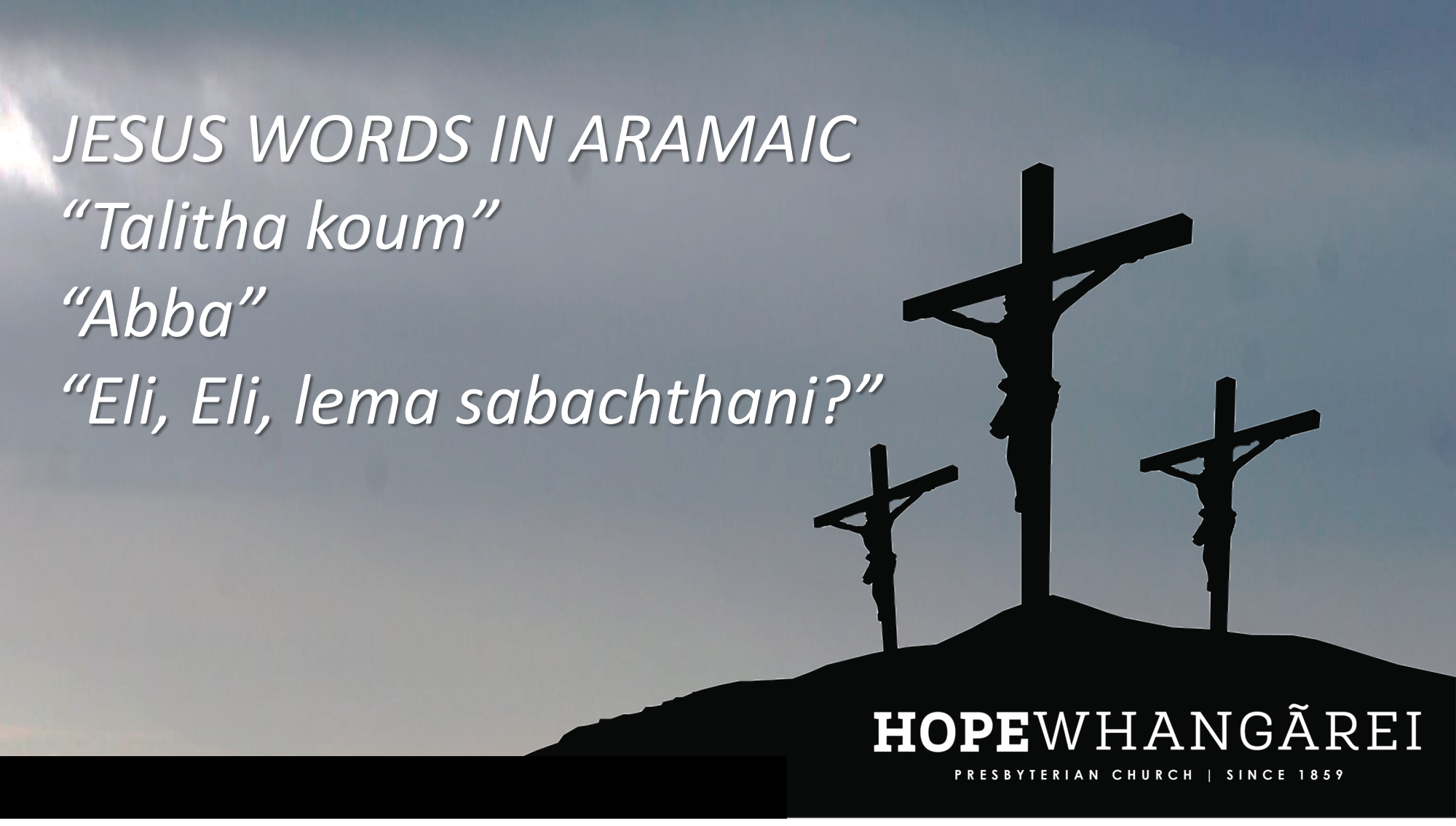
The first is that there are only three times that Jesus words are recorded in the gospels in Aramaic. Aramaic was the language that Jesus would have spoken in everyday life. The gospel are written in koina greek which was the common trade language of the first century,  A bit like English in our day. The three instances are Talitha koum which means ‘little girl, I say to you get up’ when he raises a young girl from the dead in Mark 5:21-23. You can imagine that occurrence and those words being etched in the disciple’s memory. ‘ abba, father’ in Jesus prayer in the garden of gethsemane, abba is the Aramaic word like our dad, or even the dada of a small child, running towards their father with arms outstretched. It denotes even as Jesus is wrestling with his coming crucifixion an intimacy of relationship with God the father.  The third is here at the Cross when Jesus cries out ‘Eli Eli lema Sabachthani?  “My God, My God why have you forsaken me?’ that’s etched in the minds of the people at the cross because of the anguish. Because it is so out of character for Jesus, who even in the garden used the intimate Abba… Often people will question the validity of the gospel narratives seeing them being written many year later, but when you hear those words in Aramaic it opens the door to the accounts recorded in the gospel coming from eyewitnesses, people who were there. It is a clue, one of many, to the reliability of the gospels.


The second thing is that as you may have guessed from our call to worship and Old Testament reading this morning, Jesus was quoting the first line of Psalm 22. A psalm which when you read it talks of much of the suffering Jesus was going through and while it starts with that cry of desolation it finishes with a sense of hope and trust in God… HE has done it… which is echoed in Jesus saying on the cross in John’s gospel… it is finished. Jesus as a Jewish man would have grown up singing and learning the psalms by heart. When we find ourselves in times of great anguish and suffering and pain, the stuff we have remembered comes to mind. It is why even secular people want the Lord is my shepherd, the 23rd psalm at funerals and people will say the Lord’s Prayer as they face or in the wake of difficult times. You may remember the crowds in the street at Princess Diane’s funeral all joining in with the Lord ’s Prayer. Our Father who art in heaven echoing round the crowded streets of London. For a Jewish man saying the first line of a psalm was like shorthand for saying the whole thing. Jesus feels the desolation but still has that hope.

So let’s have a look at ‘My God, My God why have you forsaken me.’


Here at the Cross, Jesus who had been betrayed by a close and trusted friend, suffered injustice in courts, been rejected by his people, tortured, brutally nailed to that cross, and mocked on all sides, abandoned by his disciples, feels that abandonment that deep aloneness. Feels as if God has turned away. It is unthinkable but Christ who called God Abba which means father and who had said I and the father are one now faces feeling separated from God. Jesus identifies fully with the emotional and spiritual side of human suffering. You catch some of the distance in the word Eli which is a formal address for God, rather than abba or father.

We find it hard to hear because we wonder if it means that Jesus despaired and lost all trust in God. The first thing we need to realise is that this saying is first and foremost still a prayer. The Jewish bystanders understood that, they believed that he was crying out for Elijah to come and save him… Elijah in Jewish thought was the one who would come to redeem his people…so they waited to see if he would. Its implication is that despite a lack of presence there is still that trust and faith in God. Still the trust that Jesus had shown in the garden of gethsemane when he prayed Father not my will but yours be done. It is still a prayer of trust because of the context of Psalm 22, which finishes with hope.


When we look to the cross we can focus on the violence and physical suffering of crucifixion. But here it opens the window on the depth of the spiritual and physiological suffering as well. Often people will wonder about the goodness of God who would allow his son to suffer, but in the cry of My God, My God why have you forsaken me’ we get a sense that not only does Jesus suffer, but in fact God the father suffers as well. The trinity that community of love at the heart of our understanding of God, where the only way to describe God is one endures that sense of separateness, as the whole of the Godhead works to make it possible for us to be bought back into relationship. It shows not only the depth of God’s identification with our human suffering, it shows the depth  of God’s love for us, willing to endure the pain and sense of isolation and separation to bring us back into relationship, that we too could become children of God and know God initially as our abba, our heavenly parent.

My God My God why have you forsaken me also offers us a way of looking at what is happening at the cross as well. If we are talking in terms of ways of understanding the cross, what we call theories of the atonement, we might talk about the fact that as Jesus had prayed father forgive them they know not what they do. Which we looked at in the first of our talks in this series, that God answers that Prayer by laying our wrongdoing on Jesus. Which means that Jesus also experiences the separation from God because God is holy and righteous and cannot abide with sin. By doing that and dying in our place he pays the price for what we have done wrong and in return offers his righteousness to us. 

But My God My God why have you forsaken me also speaks to the very heart of the human condition.


As we said before it is very much a human prayer. It is very much a human response to issues of trouble and suffering, on a personal and societal scale. Feeling that absence of God. Wondering where are you God. By using it here Jesus opens the possibility for us to see that having those feelings and experiencing that absence does not mean we stop trusting or having faith. Old Testament scholar Walter Breuggermann, talks of seeing three types of psalm in the book of psalms. Psalms of orientation where everything is going along as it should, what we might call the happy clappy songs. Full of joy and aware of God’s presence and goodness. Another is what Breuggermann says are psalms of disorientation, where it feels as if you’ve gone to the beach and been caught in a large set of waves, picked up and spun round and round and dumped hard and you don’t know which was is up. You know there are times like that, and the disorientation makes you feel separate from God, you only have time to gasp for air before the next wave crashes down on you. The third category of paslms Brueggermann calls psalms of reorientation, where the problem and suffering may not have gone away but despite the feelings of abandonment, the psalmist has come to a place of quite trust in God. Jesus on the cross shows us that example of faith amidst the turmoil of life. Spoiler alert we will see it come through it several other saying… It is Finsihed… into your hands do I commend my spirit.


The second thing it says to us is that in those times of darkness and difficulty we can bring our prayers to God, knowing that we bring them to someone who has experienced the depth of human pain and suffering who understands and identifies with that sense of desolation.  It may sound a bit flippant to say it, but it is profoundly helpful in the depths to realise that our God knows where we are, because Jesus has been there. As Adam Hamilton puts it in his book final words “we remember that the one to whom we pray in our darkest hour knew firsthand the feelings of hopelessness, doubt, and despair.’ We remember that his cry of why came from a psalm that points towards God’s ultimate deliverance.


Finally, Jesus example of being willing to identify with our suffering invites us to follow him into places where we risk knowing and feeling the abandonment of God. To go with  faith that Jesus in those situations with us can lead to his resurrection presence and kingdom change. Dietrich Bonhoeffer was a german pastor, theologian and writer in the 1930’s. His book the cost of discipleship was a best seller, and still is very popular today. Bonhoeffer was doing a speaking tour of America just before the Second World War, and people were receiving news that Hitler had started to crack down on protestant churches who were prepared to speak against his regime and its excesses. The Americans who had sponsored Bonhoeffers speaking tour exhorted him to stay in America. But Bonhoeffer refused, his critic of the American church was that it was not prepared to face suffering. He went back to Germany, where he was censured, eventually imprisoned and final executed just weeks before the end of the war. His letters from prison speak of the fact that even in that difficult place, as he cared for his fellow prisoners and even his guards and those who were mistreating him, allowed him to understand Jesus teaching more fully, he was aware of brining Jesus light into that dark place.

 Arch Bishop Welby’s words in that BBC interview could have come across as distance and while well-meaning rather hollow. Except in the same interview he spoke of not having privileged position during the pandemic, but rather that he chose to work as an assistant chaplain in a hospital. He spoke of sitting and holding the hand of a woman as she died of COVID. Of praying with a mother of a premature baby in the same hospital deeply anxious about her child’s safety. That may sound heroic, and maybe you think I’ve go a bit of a clergy crush on Justin welby, but he would deflect being sen as a hero… He said the hope he had in the face of the pandemic was not only, not surprisingly, the resurrection of Jesus Christ, but things like the courage and compassion of the medical team the prayed with at the start of their shift. The concern and care of people for one another and a desire and determination to see the medical system become more just in the wake of COVID rising in the community. The My God My God why have you forsaken me was answered through Christs presence with ordinary people as they stepped in a served in the dark places, that could easily feel abandoned by God.


‘My God My God why have you forsaken me ‘ Christ identifies with the depth of our pain and suffering, our doubt and questioning, that sense of desolation.

My God My God why have you forsaken me’ God suffers that sense of abandonment so we maybe bought back into relationship

My God, My God why have you forsaken me’ We have a God who understands and has been there when we pray from our dark places.

My God my God why have you abandoned me?’ Jesus invites us to follow him into those places, with trust in the resurrection hope.

Monday, February 22, 2021

the Little Ones: Gospel Humility and Compassion (Matthew 18:1-9)

Henri Nouwen is one of the most influential Christian writers and thinkers of the twentieth century. He taught at top universities in the US for over twenty years and was a  rising star of Christian acadamia. But then his life took an interesting turn. He spent a year’s sabbatical at l’Arche community in france. A community set up to live alongside people with mental and physical disabilities. It impacted his life so much that he was willing to give up teaching and accept a call to become a pastor at the L’Arche Daybreak community in Toronto, Canada.

Henri meet Adam there and took on part of the responsibility for caring for Adam, who was severely disabled, helping him with his morning routine… Nouwen writes

“ helping Adam meant waking him up at 7:00am, taking off his pajamas and dressing him in a bathrobe, walking him to the bathroom, shaving his beard, giving him a bath, choosing his clothes for the day, dressing him, combing his hair, walking with him to the kitchen, making his breakfast, supporting his glass as he drank, brushing his teeth, putting on his coat, gloves, and cap, getting him into his wheelchair, and pushing him over the pothole-rich road to daybreak day program, where he would spend the day until 4:00pm.”

Nouwen does not romanticise the nature of his relationship with Adam. In his book ‘Adam: God’s beloved” he talks of the struggles he had… he thought at first that they had put the neediest member of the community in the hands of the most incompetent’. He talks of learning not to rush Adam along, as it resulted in him having major seizures, but to learn to go at Adam’s pace.. Nouwen came to appreciate the time spent with Adam and value the privilege of knowing and loving him. Time with Adam became Nouwen’s quite time, he comments about how Adam who could not speak was able to teach him…

‘ His wonderful presence and his incredible worth would enlighten us to comprehend that we, like him, are also precious, graced, and beloved children of God, whether we see ourelves as rich or poor, intelligent or disabled, good-looking or unattractive.”

The same kind of learning that Jesus wants to convey in the passage we are looking at today in response to his disciples question ‘who is the greatest in the kingdom of heaven?”.

This year we are working through Jesus teaching on the kingdom of heaven In Matthew’s gospel. The series is called ‘A 2020 vision of the kingdom of God: the Manifesto, mission, meaning and means of the much awaited kingdom of Heaven’. In Chapter 18 Jesus talks about the means of the Kingdom of God… speaking of the sort of community his disciples were to form, what the church should be like. A kingdom of God community where the agenda of this world is turned on its head, where it is not about greatness and status but humble trust and service, not about having our own way but careful care for others, working together on reconciliation and forgiveness. A community not about the powerful but the powerless.

It starts with that question that the disciples ask Jesus “Who then is the greatest in the Kingdom of heaven?” this question comes after a period of Jesus ministry where the disciples had come to realise that Jesus was indeed the messiah, God’s Son. Peter had confessed it, it had been confirmed by Jesus feeding miracles, walking on water, and for at least three key disciples by the transfiguration. The obvious answer to the question who is the greatest in the kingdom of course is Jesus, the messiah, however Jesus had spoken of his messiahship leading to his suffering and death. And the disciples understanding of the Kingdom was still shaped by the aspirations of the Jewish people of an independent Israel as a world power. A political military messiah, that would lead to power and status. In the other gospels the question is crouched “who will sit at your right hand and you’re left when you come into your kingdom”. Who will get the top jobs, be the top dogs.

Jesus puts a child in the middle of them. An object lesson and tells them unless they change and become like this child they will not enter the kingdom. Unless they take the lowly position of a child they will not be the great in the Kingdom of heaven. We struggle with what Jesus is meaning. Does it mean having a childlike faith a sense of innocence? A naive unquestioning faith? Maybe it would be nice if it was… But that does not answer the question Jesus is asked. Maybe it represents our cultures understanding of children. But we are talking about status and position in the Jewish and first century world, a child had no status of their own. Child mortality rates were high, children’s value were as workers in the family farms or business. Bible commentator Michael Wilkins puts it like this…” The humility of a child consists of their inability to advance his or her own cause apart from the help and resources of a parent.” The kingdom of heaven is not about earning or deserving God’s favour. But rather it is about knowing that we like a child are totally dependent on our heavenly father and his love for us, his love shown in the sending of his own son Jesus Christ to live, suffer and die for us that enables us to come into the Kingdom… by god’s grace not our greatness, God’s mercy not our merit.

Then Jesus challenges the thinking of the disciples who are looking at who is the greatest, by speaking of the fact that these little ones are of utmost importance to God. The Pharisees, and well all of us, I guess, have this tendency to see powerful people in the community, rich people in the community, strong people in the community, adult people in the community as more important than others, poor, low status, children. But the community that will be the embassy of God’s Kingdom is to have a different perceptive. Children and the little ones, the powerless and the easily ignored and overlooked are important and central to the kingdom of heaven. They matter to God, so they should matter to his people. The kingdom of heaven is different, we all enter realising our spiritual poverty and putting our trust in God’s great grace, that affirms the value of all  and importance of the little ones and in particular children.

Then Jesus reinforces this point when he sounds a lot like the Godfather rather than God’s son. He says that it would be better for anyone to have a millstone put round their neck and thrown into the sea, a first century version of concrete overshoes and thrown in the east river, than causing one of these little ones to stumble or be lead astray.  He challenges the disciples to be careful about their own lives. He uses the hyperbole of mutilation, of plucking eyes out and cutting off feet and hands to warn and extol his disciples to ensure they had a very strong self-discipline in place to ensure they did not cause those little ones to stumble. It was better that they entered the kingdom without eyes and hands and feet rather than being thrown in to the fires of eternal judgment. The continuing in sin in such a way as to lead people astray is a sign that we were not genuine followers of Jesus in the first place.

That is quite a heavy way to finish really. So what does this passage have to say to us today.

First and foremost that we are a community that is founded on Grace. It is humbling to think that we like that little child have no ability to advance our own cause with God, that we are dependent on the action and love of a parent, our heavenly Father. The great thing is that God does loves us, and God calls us into relationship with him, invites us into his kingdom through his son Jesus Christ. We are God’s beloved, his adopted Children. It goes against a world where we think of ourselves as independent, able to make it on our own effort and ability, a world where questions about who is the greatest, status, position, power and prominence matter. The kingdom of heaven flips that on its head and speaks of being greatly and sacrificially loved, graciously welcomed in, based on the power and promise of God, God’s greatness not ours.

Secondly that we are a community that is to be characterised by that grace. That reflects the love of God in how we see and treat other people particularly the little ones. When we humbly realise how much we are dependent on God’s grace it allows us to see the value of people around us. That the little ones, those that the world does not see or does not see as having power or position of being important, who may be able to be sidelined and thrown away, are precious and equally God’s beloved. Humble gratitude leads to humble service, receiving grace leads to gracious care and concern for others. In fact as Henri Nouwen found out when you see the belovedness of the little ones you start to realise the magnitude for God’s love for you.

That grace is put into action by seeing that we do not cause those little ones to stumble, that we look at self-discipline to make sure that does not happen. In the epistles we see this aqpplied in different situations. To the Church at Corinth Paul has to write to tell the church not to simply gather and let the rich people eat all the food, because the slaves who were Christian brothers and sisters, couldn’t come till they had finished their work for the day and often all the food would be gone, the ones who needed it most went away empty. James, writes to his church and tells them not to simply give the important and rich people the best seats and to say to the poor go stand down the back, sending the hungry away with a simple God bless you. Have a nice day… we need to look at how we act in the same way towards these types of little ones.

When we think specifically of children it would be easy to talk of the horror of paedophile priests and other forms of abuse , as they seem to fit into Jesus description of actions that speak of lives where people have allowed sin to destroy them and traumatise little ones. In a very practical way the Churches response to put in place child protection policies is a self-disciplining of ourselves to guard against as much as we can the possibility of such abuse.  It also sets a basis of the churches grieving over and opposition to abortion and euthanasia.  But when we think of the question who is the greatest it challenges us on more relatable level as well. In what ways does meeting our own needs and our own preferences and our own comfort cause the little ones to stumble.

I worked as the youth coordinator for the old Auckland presbytery for four years, and one of the things I found very sad was watching churches hold on to their traditions and ways of doing things at the expense of their children and young people. Sadly the Church in the western world is split along the lines of the cultural gap caused in the 1960’s by the massive influence and change in culture by the mass media. We could equally talk of churches where older people feel sidelined and unwanted.  Our vision as a church is that we want to be a flourishing Christian community that is intergenerational, that values all generations, and that will mean we all have to be prepared to put aside wanting it the way we like it for the sake of caring about others of welcoming in the little ones.

I wanted to finish the sermon today with a killer illustration an example that would tie this all together. All I could think of was the obvious answer to the question who is the greatest in the kingdom of heaven… Jesus Christ, who showed his greatness through giving his life for world. Whose love for all us little ones lead him to the cross. Paul writing the church at Philippi puts Jesus word in a positive but even more challenging way…

Do nothing out of selfish ambition or vain conceit. Rather, in humility value others above yourselves, 4 not looking to your own interests but each of you to the interests of the others.

5 In your relationships with one another, have the same mindset as Christ Jesus:

6 Who, being in very nature God,
    did not consider equality with God something to be used to his own advantage;
7 rather, he made himself nothing
    by taking the very nature of a servant,
    being made in human likeness.
8 And being found in appearance as a man,
    he humbled himself
    by becoming obedient to death—
        even death on a cross!

9 Therefore God exalted him to the highest place
    and gave him the name that is above every name,
10 that at the name of Jesus every knee should bow,
    in heaven and on earth and under the earth,
11 and every tongue acknowledge that Jesus Christ is Lord,

    to the glory of God the Father. 

Wednesday, February 17, 2021

The Much Awaited kingdom: The Parable of The Sheep & The Goats (Matthew 25:31-46)


In the ethos section of the proposal to come together and become One, on which HopeWhangarei was constituted it says “We aspire to truly understand, embody and proclaim Jesus’ good news about the Kingdom of God.” And to help us with that aspiration this year we’ve been working our way through a sermon series  called ‘A 2020 vision of the kingdom of God: the Manifesto, Mission, Meaning and Means of the Much awaited Kingdom of Heaven in Matthew’s gospel. Looking at the five blocks of Jesus teaching on the kingdom of Heaven in Matthew: the Sermon on the Mount, the manifesto in Matthew 5-7, Jesus instructions to his disciples as he sends them out on a short term mission in Matthew 10, the mission the parables of the kingdom in Matthew 13, the meaning, Jesus teaching about being a community in response to the disciples question who is the greatest in the kingdom, the Means how we are to live humbly as a community  in Matthew 17-19 and the Olivet Discourse, his other sermon on the Mount… of olives, where Jesus speaks of the destruction of Jerusalem, the end of the age and his coming as king and how his disciples are to be ready and on watch, the Much awaited,  that’s in Matthew 24-25. 

Today we finish that whole series by looking at the surprising fourth of four parables with which Jesus ends his Olivet Discourse. The sheep and the goats. The fourth of four parables which in Matthew’s gospel is Jesus last teaching before his betrayal, crucifixion, death and resurrection. It ends the teaching ministry, a ministry that had started with the revolution of grace in blessed are the poor in spirit for theirs is the kingdom of heaven ending in it being shared and shown in practical care and concern for the least of Jesus brethren. It ends the four parables with which Jesus had told his disciples what it meant to wait for his kingdom to come in its fullness. To be on watch and alert, to preserver in doing good, in the parable of the unfaithful servant, to be Prepared, in the parable of the wise and foolish bridesmaids, to be productive in the parable of the talents and now in the parable of the sheep and the goats. That we are accountable to God for how our faith in him is worked out.

Let’s look at the parable.

Well in actual fact it is more a picture of the coming of the Son of man as King and how he will judge the nations. Unlike his first coming his advent, almost incognito, there will come a time when Jesus will come in his full glory, as if the veil is taken off and we know who he is indeed. Jesus uses the imagery that his disciples here would expect of the messiah as the conquering King with his armies, angelic armies,  with his sitting on his exalted throne, assembling the nations before him. This is right before Jesus crucifion, and we need to be reminded that Jesus death is portrayed in all the gospels as a coronation, the inauguration of his Kingdom.

Jesus then switches and uses an image from the countryside around him, one infused with much meaning from Israel’s past. The king on the throne is like a shepherd who separates the people into two groups, like separating sheep and goats. In Palestine it was not uncommon to allow the sheep and the goats to graze together during the day, they ate the same food, but goats needed more protection and care in the cold nights, so it was common to see shepherds splitting the flocks as sunset. Now we have a very western European idea of sheep and goats which make it hard to realise what is being said here. Our cold weather sheep, grown for their wool, look totally different from our goat population. But in the Middle East there was not much of a difference in appearance between sheep and goats. One commentator said that the only difference was that sheep had tails that went down and goats had tails that went up. In this we find echoes of parables like the wheat and the weeds in Matthew 13, where Jesus says it is only in the harvest that you can truly separate those two different plants which had been sowed, one by the farmer the other by an enemy, in the same field. Again like we will see in this parable the difference is in the crop or fruit which is produced. So really there is no easily discernible difference between the sheep and the goats, by sight.

The sheep are placed on the right side of the king, which in royal circles signifies a place of honour and favour. The goats are placed on his left which is seen as a place of displeasure.

The sheep are welcomed into the blessing of the Father, the kingdom that was prepared for them since the creation of the world.  The surprising thing about that however is the reason why. Most of us would think it is because they had accepted Jesus as their lord and saviour, and that’s part of it. But rather it is because they had fed and given water and clothed and visited and welcomed, cared for Jesus when he was hungry thirsty, naked, a sign of abject poverty in Jesus day, a stranger, and a prisoner or when he was sick. 

The second surprise is that the sheep are at a loss. They say when did we see you hungry and feed you, or thirsty and give you water? When did we see you a stranger and welcome you in, or needing clothes and cloth you? When did we see you in prison and go and visit you? They are genuinely perplexed at what Jesus is meaning. It is interesting that by the end of the week the disciples would see Jesus in all those situations at his passion. His radical and redeeming identification with the worst of humanity and our pain and suffering, stripped naked abandoned, beaten, thirsting on the cross, in agony, and dying.

 But Jesus answer is again surprising. AS you have done this for the least of my breather, my brother’s and sister’s, you have done it for me… Now there is some discussion over who Jesus is talking about here. Brothers and sister could mean his followers and disciples, and the nations are being judged for how they/ we are treated. It could mean fellow believers, like in the parable of the unfaithful servant the first of Jesus parables in the Olivet discourse. It can mean the poor and the least in society and the world, who are equally made in God’s image, objects of his love and compassion, the focus of the coming of his kingdom. All those things challenge us to think of others in light of the gospel and the kingdom of God.

The goats, on the other hand, and that is a proper use of that phrase really isn’t it…on the other hand… are told to depart from Jesus presence to the place that was set aside for the devil and all his angels, a place of rejection by God. Jesus words to the goats are the mirror opposite of what he had said to the sheep. They did not feed him, give him drink, cloth him, welcome him in, visit him care for him. The goats also answer in a surprised manner, that they had never seen Jesus in any of those states. Again Jesus surprising answer is as they hadn’t done it for the lest of these, and his hand may well have swept across the people on his right, then you have not done it for me.

The punch line is that they are sent away to eternal punishment and the righteous to eternal life. Really when we think of eternal punishment, our minds and imaginations are more developed around Dante’s inferno than the scripture. Here it is enough to say that that punishment is the polar opposite of eternal life, in God’s kingdom. Separation from God, darkness with no light, it does challenge us to be aware that we do not want people to be in that position.

How does this speak to us.

Firstly  it may not surprise you that this passage has been wrestled with because of the surprising way in which the sheep are separated from the goats. When we look at it with eyes that are definitely looking through a post reformation lens we are concerned that it speaks of salvation by works, not by grace alone. Maybe that speaks to our own nagging doubt that just somehow we need to earn God’s approval and love. But that is not the case, the sheep seem genuinely surprised that they have done anything to please God. Rather it is that just like with the kingdom of God being planted in the good soil producing  a harvest of 3o 50 100 fold, here the kingdoms presence in a person’s life naturally will work its self out in care for those in need. Salvation is an always has been by grace and faith in Christ, but it is a faith that actually produces change. At the end of the Sermon on the Mount Jesus had said that the difference between building your life on a solid foundation or a foundation that would not stand was that we heard the words of Jesus and obeyed them.

Here we see that put into action in the way in which we treat the least of our brethren, and the least around us. James puts it very succinctly when he says faith without works is dead. That does not mean the upfront public ministry kind of things that count but the genuine love and care shown to those in need. A REFELCTION OF Jesus humble service that bought our salvation. The one who came for the lost and the sinner, the tax collector and the outcast invokes in us a similar care as Michael Wilson puts it “We serve because we a have been served, we love because we have been loved, we lift up because we have been lifted up”, you can go on ‘receiving grace leads to extending grace”, tasting mercy leads to offering mercy’.  Love shown to the least is the sign of genuine change and transformation… it is the hall mark of the kingdom.

Another surprising thing is how the kingdom of God seems to be shown in such small events that have such big consequences. Chaos theory is a branch of mathematics where people observe that extremely small variations in a large data set or system can have far reaching effects. It was first described by MIT mathematician Edward Lorenz in 1961. Fortunately he had the sense to give this phenomenon a more poetic phrase, the butterfly effect, which came from his famous paper ‘Does the flap of a butterfly wing in brazil set off a tornado in Texas?. I don’t know it can be argued that such small things can impact the weather conditions, however in Jesus parable we see the Kingdom of God reaching down into our world in small almost inconsequential ways that have eternal impact. A glass of water given to a thirsty person, a meal given to the hungry, clothes given to the person who has none, a visit, interest shown to a prisoner, caring for the sick. Even the words we say, how we treat our neighbour. Stopping to help even when it is inconvenient. Seeds of the kingdom that grow and have a harvest in us and the world around us.

Lastly while in all the parables in the Olivet discourse, we see that the Jesus figure has gone away and is coming back, here we are told that Jesus is present in the world with us. Theologically we know that Christ “Immanuel” God with us, is present with us as he promised, and lo I am with you till the end of the age. We equate that with Jesus being present with his people by the Holy Spirit with us and within us. We see Christ presence in the lords table in communion, Christ meets us in that meal… in the elements which represent for us the body and blood of Jesus. But here we see Jesus is also present in the lives of the least, the people in need around us. In this world… When we care for them we are caring for Jesus. Mother Theresa used to call her order of nuns a contemplative order. Which surprised many people, she said they would spend time contemplating the face of Jesus in prayer and the scriptures then they would go out and see the face of Jesus in the poorest of the poor.” AS Christians we have a great incentive to care for people for not only are they people who are made in God’s image they are people who embody Christ. That if we have experienced Jesus love we will humbly serve as if they are Jesus our Lord and saviour. 

Surprisingly sheep and goats are hard to tell apart, but this summer we are going to be looking at the first letter to john and John has a simply way of doing it. Because God first loved us and sent his son to die as a sacrifice for our sins, let us love one another. Those who do not love have not seen God… The kingdom of God seems to boil right down to that we are invited in our brokenness and poverty to come to Jesus who welcomes us and fills us up, and we are to fill up and welcome in those who are broken and poor so they too may encounter and come to know the kingdom of God.